
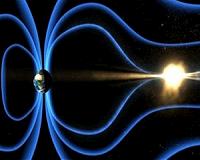
The University of Maryland possesses the world's largest spinning model of the Earth's interior. It is a stainless steel sphere ten feet in diameter that rapidly whirls and it is used for different geophysical experiments. One of them is being conducted by geophysicist Daniel Lathrop who tries to predict when the Earth's magnetic field will next reverse.
During the lifetime of our planet, the fields have exchanged their places many times, which can be proved by marks in volcanic rocks. These marks show that the last switch happened 780,000 years ago, when humans were just learning to make fire.
Of course, the next reversal will not be fatal for humanity, but the problem is we don't know what to expect. A reversal is a slow event that takes about a thousand years, during which the field will weaken. In what way will this process affect the sun or the behaviour of birds, for instance? And most interestingly, when will it happen?
And the giant sphere can give an answer to this. Within it another sphere is placed and the space between the two is filled with 12 tons of liquid sodium, heated to 250 degrees Fahrenheit, which simulates the liquid iron in the Earth's outer core. When the construction is spinning, sodium forms electrical currents that generate the magnetic field in a process called a dynamo. Daniel Lathrop and his colleagues hope to find out how Earth's field forms and evolves.
The sphere is now spinning at 45 miles per hour with a little help from electromagnets. When the spinning reaches 90 miles per hour later this year, the sodium might generate a field without additional help. If this happens, and given that one second of the experiment equals 5,000 years of Earth time, the researchers hope to calculate the time of the next reversal.
