
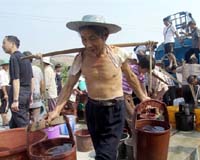
Areas of western China are enduring their worst drought in 50 years, with at least 14 million people suffering from a shortage of drinking water, state press reported Thursday.
Thousands of people are being admitted to hospitals daily due to heatstroke as temperatures regularly exceed 35 degrees Celsius (95 degrees Fahrenheit), while large tracts of farmland have been devastated, the China Daily said.
The worst hit area is Chongqing municipality, which has had no rain for more than 70 consecutive days and where two-thirds of its rivers have dried up, according to the newspaper.
At least 14 million people across west and southwest China, including 7.5 million in Chongqing, do not have adequate access to drinking water, the paper said.
In Xiwang village, near Chongqing, the dry spell had caused the well water to fall so dramatically that only the most basic necessities could be covered.
"Most grown-ups in the village haven't had a shower for 40 days," Cai Bangshu, a Xiwang resident, told the Beijing News.
With scarcely enough drinking water to serve humans, in some cases animals did not receive enough to survive.
The Chongqing Business News described how close to 10,000 chickens had died from thirst at one farm, while the Beijing News said villagers had been forced to sell their pigs because they could not otherwise keep them alive.
Temperatures have not dropped below 35 degrees over the past month in Chongqing, and Tuesday the thermometer hit 42 degrees.
"We're receiving more than 2,000 emergency calls every day," the China Daily quoted a doctor at the city's emergency center, Lei Shixiu, as saying.
"One patient died of serious heatstroke on Tuesday."
In a bid to lower temperatures, large buckets full of ice have been placed in buses with no air-conditioning, the newspaper said.
Meanwhile prices of some foods such as leaf vegetables have soared by as much as 50 percent due to extensive damage to farmland.
About 1.3 million hectares (3.2 million acres) of crops have been destroyed, with total agricultural losses reaching 2.5 billion yuan (310 million dollars), the paper said, citing local government officials.
"The natural disaster has had a huge impact on agriculture and people's lives," Chongqing Communist Party chief Wang Yang was quoted as saying.
Other areas of western China that are being affected by the drought are Guizhou province and the Ningxia Hui region, while water supplies for Shanghai and other downstream cities to the east are declining.
China Rice Harvests In Danger From Insect Plague
Millions of tonnes of rice in central China could be lost due to a plague of insects caused by this year's unusually severe typhoon season, state press reported Thursday. Hubei province is facing its worst planthopper plague in decades, with 40 percent of rice fields being hit by the small insects that can totally destroy crops, the Xinhua news agency said.
Eastern and central China have endured eight typhoons since May, an unusually high number, and the frequent rain and cool weather from the storms are ideal conditions for planthoppers to breed, Xinhua cited experts as saying.
This year's outbreak of planthoppers is much worse than the plagues of 1991, 1997 and 1998, which all caused the loss of millions of tonnes of rice, officials said at an emergency meeting in Hebei on Wednesday.
"It is the worst outbreak I have seen since I began working in plant protection 30 years ago," Xinhua quoted one local official, Luo Xingrong, as telling the meeting.
The typhoons have left hundreds, if not thousands, of people dead or missing.
The most recent typhoon, Saomai, which made landfall on Thursday last week, has killed at least 319 people, according to official figures.
Typhoon Prapiroon, which made landfall on August 3, killed at least 80 people and Bilis, which hit on July 14, claimed over 600 lives.
Source: Agence France-Presse
