
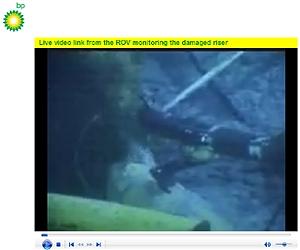
BP's live feed of the main oil leak in the Gulf of Mexico was flooded with viewers Friday, as a government team sought to pin down exactly how much oil is gushing into the water.
The video, put up on BP's website after calls to be more transparent over its handling of the environmental disaster, was made live on Thursday, but has encountered loading problems with so many users attempting to view the video.
President Barack Obama's press secretary Robert Gibbs said the move resulted from White House pressure in a post on his official Twitter account.
"10 days ago Obama Admin said BP should make public underwater footage of oil spill, another request yesterday — today, the footage on bp.com," the post read.
The White House has imposed intense political pressure on BP, saying it will keep its "boot on the throat" of the British oil giant to ensure it complies with US laws requiring it to pay for the cost of the cleanup and to compensate businesses badly hit by the disaster.
The government has created a Flow Rate Technical Team (FRTT) to develop a more precise estimate of the flow, and is mandated to issue a report on their findings by May 22.
Senators Bill Nelson of Florida and Barbara Boxer of California also pressured the British energy giant to provide the feed, to allow more precise analyses of the flow.
BP said in a statement that it has already been providing a live video feed to officials over the last two weeks, including to the Interior Department, Coast Guard, and the Minerals Management Service (MMS).
How much oil is gushing from the pipe ruptured when the BP-leased Deepwater Horizon rig exploded and sank a month ago remains a contentious issue, with BP initially putting the figure at 5,000 barrels — or 210,000 gallons — a day.
The company however now says it is siphoning 5,000 barrels a day from the leak by a mile-long (1,600 meter) insertion tube device, meaning the figure is likely higher.
Even at the lowest estimates, more than six million gallons of crude have flowed into the water since the disaster, with independent experts warning the flow could be at least 10 times higher than the current estimates.
On his personal website, Nelson provides a growing tally of the estimated number of gallons of oil that have so far leaked into the Gulf, which allows users to adjust the rate of flow to see how much has been released.
In the worst case scenario in which outside experts estimate the spill is some 4.2 million gallons a day, some 130 million gallons of oil would have leaked into the Gulf, eclipsing the Exxon Valdez disaster by 10 times.
The 1989 Exxon Valdez disaster off Alaska is to date the worst oil spill in US history.
Share This Article With Planet Earth
