
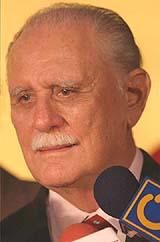
The vice president of Venezuela insisted on Wednesday that his government had the right to develop civilian nuclear power as an alternative source of energy.
"Venezuela has the absolute right to develop nuclear energy," Rangel said at a press conference.
While the country was rich in oil, it was important to cultivate renewable sources such as solar, wind and nuclear energy, he said.
Any nuclear program would be for purely peaceful purposes and in no way involve the development of nuclear weapons, he said.
"President (Hugo) Chavez has been sufficiently emphatic in saying that there is no question of constructing an atomic bomb," he said.
In an apparent reference to the United States and international rules governing access to nuclear technology, Rangel said it was "hypocritical" that some countries sought to block access to nuclear energy.
Responding to recent reports that Venezuela allegedly had approached Argentina and Iran to discuss securing nuclear technology, Rangel said the government was merely exploring the possibility of nuclear power and had made no agreements with other countries.
Rangel also rejected a report by Transparency International that described endemic corruption in Venezuela.
He said the group was "totally unqualified" to present such a report and that the problem had been overstated.
While corruption varied from country to country, Rangel said that "one of the most corrupt countries in the world is the United States."
Transparency International, an international non-governmental organization devoted to combating corruption, gave Venezuela 2.3 points on a scale of 10 in a worldwide survey. That made Venezuela one of the most corrupt countries in Latin America and the Caribbean, according to the annual index.
