
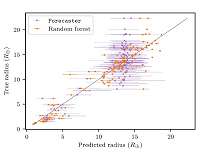
A team of Instituto de Astrofisica e Ciencias do Espaco (IA) researchers has published an article[3], led by Solene Ulmer-Moll, which shows that by knowing an exoplanet's mass and equilibrium temperature, it's possible to constrain its radius, with higher accuracy than previous methods.
Solene Ulmer-Moll, a PhD student at the Science Faculty of the University of Porto (FCUP) explains this result was obtained by using knowledge from different fields: "This novel way to forecast exoplanet radius is a perfect example of the synergy between exoplanet science and machine learning techniques."
To characterize a planet, both its mass and radius are needed, in order to find the planet's density, and from that infer its composition. But both data are only available for a reduced number of exoplanets, since the mass is often determined by radial velocity measurements, while radius is measured with the transit method.
The team developed an algorithm which accurately forecasts the radius of a wide range of exoplanets, if several other planetary and stellar parameters are known, mainly, the exoplanet's mass and equilibrium temperature.
Solene Ulmer-Moll adds: "For the hundreds of planets discovered with the radial velocity method, we are now able to predict their radius. We can then understand if these exoplanets are potentially rocky worlds."
So far, only the mass of an exoplanet was used to predict its radius, but the team is working on changing this paradigm by using other planetary and stellar parameters to strengthen their predictions.
Nuno Cardoso Santos (IA and FCUP), leader of IA's thematic line "Towards the detection and characterization of other Earths," adds: "This work beautifully puts together the expertise in our team, uniting the existing knowledge about exoplanet detection and characterization and the statistical analysis of the detected systems, using state-of-the-art mathematical tools. These are essentially the same mathematical tools that are now leading to the development of autonomous cars."
