
US President George W. Bush will push for an action plan against bird flu during the Asia Pacific Economic Cooperation (APEC) forum summit in November, a senior US official said Tuesday.
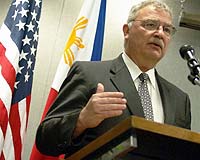
Bird flu, which has killed 63 people worldwide and has now been detected in 11 countries, could become the next major disaster to hit the Asia-Pacific after SARS and the tsunami last December, said Michael Michalak, Washington's senior official to the 21-member APEC.
The South Korean city of Busan is to host the summit on November 18-19.
"This is an issue that is gaining momentum internationally," Michalak said in a press briefing.
"We believe APEC will make a strong statement on that issue, and will try to issue an action plan for APEC economies to try to double research, do some capacity-building in preparing our economies to better face this potential pandemic," Michalak said.
If an avian pandemic breaks out, there would be border closures affecting the global air traffic of goods and people.
"There would be significant economic and social impacts," Michalak said.
The action plan would outline a "set of principles" for APEC economies to follow including transparency in any investigations into suspected outbreaks.
The APEC nations, which include the United States and China, make up some 60 percent of the world's economic activity.
APEC economies must be "open to medical teams to be able to find out what going on in the given economy," Michalak said.
"It's got to be speedy. In other words, when it looks like there is a suspected case, the samples have got to be moved to international organizations such as the FAO (UN's Food and Agriculture Organization) so that appropriate steps can be done," Michalak said.
"And there has to be a spirit of cooperation between donor countries and affected countries."
At present the H5N1 strain of bird flu can be lethal for humans but is not very contagious, nor can it be easily transmitted from person to person.
The World Health Organisation's biggest fear is that H5N1 may mutate, acquiring genes from the human influenza virus that would make it highly infectious as well as lethal.
The WHO has said that millions of people could die around the world if bird flu spreads out of control.
Bush at a UN summit this month launched an "international partnership" between potential donors and countries affected by bird flu.
