
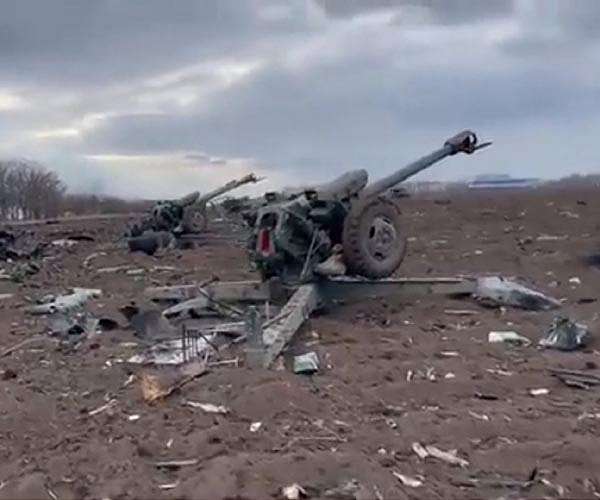
Having failed to make a decisive advance in the early phase of its Ukraine campaign, the Russian army is now facing a thaw that could make progression on key routes problematic due to mud.
Like the armies of Napoleon and Hitler before them, Russian mechanised divisions are likely to be slowed down or halted as unpaved roads become treacherous quagmires.
Locals have a word for the twice-yearly season of mudbound roads in the region: Rasputitsa, a term that refers to both to the seasons themselves, and the resulting muddy conditions on the roads created by thawing snow in the spring combined with wet weather, or heavy rains in the autumn.
As President Vladimir Putin massed his army at the Ukrainian border, many Western experts expected him to abstain from marching in as the weeks passed, because time was running out before the great thaw.
"Early spring is a bad time to invade Ukraine if the main roads have been destroyed, a task well within Ukraine's irregular warfare toolkit," wrote Spencer Meredith, a professor at the US National Defence University, in an article published a week before Putin gave the order for the invasion.
While some experts may have misread Putin's intentions, their assessment of weather conditions has been spot-on, as pictures of Russian tanks stuck in the mud have begun to appear frequently on social media.
"There were already numerous episodes when Russian tanks and other equipment drove into the fields and got stuck. So the soldiers had to leave the equipment and go on foot," said Mykola Beleskov, an Ukrainian military analyst.
He added: "The situation will worsen as the weather warms up and the rains start, it'll just chain them to the ground."
– 'Not in Putin's favour' –
Military historians have always known that Rasputitsa — sometimes called "General Mud" — can thwart even the mightiest armies.
In 1812, the retreat by French emperor Napoleon's troops could not be completed in time before the harsh winter because it was severely slowed down by mud.
More than a century later, the heavy Ukrainian soil got in the way of Hitler's march on Moscow, and later of Russia's counter-offensive of 1943.
"The weather is not in Putin's favour," tweeted military historian Cedric Mas at the weekend.
Like during those historic campaigns, the Rasputitsa is expected by the second half of March and to last for three to four weeks.
Worsening conditions will leave Russian generals little choice but to order tanks and armoured vehicles to stick to the main roads, making them more vulnerable to attack, according to Michel Goya, a military historian.
That Putin launched the offensive regardless of those dangers could support the analysis by several Western experts that the Russian president underestimated Ukraine's resistance, and overestimated his own army's capacities.
Either way, the mud is fast turning into one of Ukraine's major assets as it fights the Russian invasion, along with Western supplies of anti-tank Javelin missiles, ground-to-air Stinger missiles and Ukraine's own astute use of social media, according to Jason Lyall, a professor in government at Dartmouth College in the US.
"The Four Horsemen of the Ukrainian Army: Javelin, Stinger, Rasputitsa, TikTok," Lyall tweeted.
Battleground Ukraine: Day 13 of Russia's invasion
Paris (AFP) March 8, 2022 –
On the 13th day of Russia's invasion of Ukraine Tuesday, Russian forces were encircling several key cities as the international community pressed to allow the evacuation of civilians from besieged centres.
Kyiv remains under Ukrainian control but at increasing risk of itself being encircled, with observers fearing Russia could step up the intensity of attacks in the next days.
Here is a summary of the situation on the ground, based on statements from both sides, Western defence and intelligence sources and international organisations.
– The east –
Kharkiv remains in Ukrainian hands despite increasingly intense Russian bombardment and the city is likely now surrounded, according to Western sources.
Russian forces are also pressing an offensive through the Russian-backed separatist Donetsk and Lugansk regions although how far they have penetrated remains unclear.
There has been heavy fighting around the city of Sumy in northeast Ukraine. Civilians began to be evacuated through a humanitarian corridor after 21 people, including two children, were killed in Sumy overnight.
– Kyiv and the north –
Kyiv remains under Ukrainian control, despite heavy bombardments, although Western observers point to a major Russian column of hundreds of vehicles outside the city.
Russian forces appear to be attempting to complete an encirclement of the city by moving towards its southern outskirts.
Civilians on foot took an unofficial escape route out of the bombarded Kyiv suburb of Irpin northwest of the centre.
Ukrainian forces also retain control of the northern town of Chernigiv, which has seen heavy civilian casualties in recent days and appears to be encircled.
– The south –
Russia has besieged the strategic southern city of Mariupol and attempts to evacuate an estimated 200,000 civilians from the city have so far failed.
Taking the city would allow Russia to link forces, pushing north from the annexed Ukrainian peninsula of Crimea with their forces from the east.
The famed port city Odessa remains under Ukrainian control and has so far been spared fighting. But Ukraine's President Volodymyr Zelensky said he was aware of intelligence that Russia planned to bomb the city.
Russian forces last week took the southern city of Kherson, just north of Crimea, and there is now heavy fighting for control of the city of Mykolayiv to the northwest.
– The west and centre –
The west of Ukraine remains largely spared from the fighting. The main western city of Lviv has become a hub for foreign diplomatic missions, journalists and Ukrainians seeking safety or wanting to leave the country.
Zelensky said Sunday the civilian airport in the central city of Vinnytsia was destroyed by Russian rockets. Rescue services said five civilians and four soldiers were killed.
– Casualties –
The United Nations said Tuesday it had recorded 474 civilian deaths in Ukraine, including 29 children, although the true toll could be far higher.
Ukraine and Western sources claim that the Russian death toll is far than Moscow has so far admitted to.
Ukraine says more than 12,000 Russian soldiers have been killed while the US Defense Department says it estimates between 2,000 and 4,000 Russian soldiers have died.
Russia's only official toll, announced last Wednesday, said 498 Russian troops had been killed in Ukraine.
– Refugees –
Over 2 million refugees have fled Ukraine since the invasion, more than half going to Poland, according to the UN refugee agency.
