
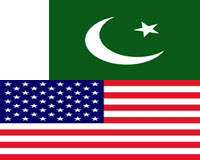
The United States on Tuesday hit back at Pakistani critics of a giant aid package, rejecting charges it was violating the nuclear power's sovereignty in the fight against Islamic extremism.
Pakistani Foreign Minister Shah Mehmood Qureshi rushed back to Washington just days after a previous visit as his nation's powerful military led a nationalist backlash against the five-year, 7.5 billion-dollar aid plan.
In a hastily arranged meeting, Senator John Kerry — a key author of the aid package — promised to come up with a congressional statement clarifying that the United States was not imposing conditions on Pakistan for non-military aid.
"There is nothing in this bill that impinges on Pakistani sovereignty — period, end of issue. And we have no intention of doing so," Kerry told a joint news conference with Qureshi.
The legislation, with its stated hopes for Pakistan to tackle extremism, does not "require anything of Pakistan that isn't already the stated policy of the government and opposition parties," he said.
The package aims to build schools, roads and democratic institutions and improve the plight of women, all part of a US drive to thwart the appeal of Islamic extremists in a nation gripped by violence.
Qureshi said he felt obligated to return to Washington due to the uproar in Pakistan, where anti-American sentiment runs high.
"It is my responsibility as a friend of this relationship — a person who wants to deepen and strengthen this relationship — that we address these concerns," Qureshi said.
Kerry said the package marked a landmark US commitment to Pakistan's people — not necessarily its government — and noted that it came despite Americans "going through their own economically challenging times."
Kerry plans to travel Wednesday to Pakistan and Afghanistan for a first-hand look at the neighboring countries which President Barack Obama has made a top priority, his staff said.
Obama is also mulling whether to send thousands more troops to Afghanistan, part of a two-pronged strategy to root out extremists from the region.
Robert Gibbs, Obama's spokesman, said the president would sign the aid bill "soon," adding that critics of the package "either are misinformed or are characterizing this in a different way for their own political purposes."
US officials have privately voiced concern about whether civilian President Asif Ali Zardari, who ended a decade of military rule last year, had full control over the army and intelligence.
While the package went through Congress with support from both parties, some US House members have also voiced unease, saying it was too costly in a troubled economy or doubting Pakistan's sincerity in fighting extremists.
A leaked memorandum from a senior economist at the US aid agency recently protested that Richard Holbrooke, the US special envoy to the region, was insisting on funding Pakistani groups too weak to handle such major projects.
The US-India Political Action Committee, which represents Indian-Americans, has worried that Pakistan could misuse US support for counter-insurgency efforts and called for better tabs on Pakistan's nuclear program.
Oeindrila Dube, an expert on foreign aid at the Center for Global Development, said the package had a "disjuncture" by focusing on non-military support but seeking progress on military goals.
The bill also lacks clear benchmarks for how to quantify progress, she said.
"But I think, ultimately, it is a rather large chunk of change and the incentive of the Pakistani government will certainly be to accept the aid package," she said.
"From the US side, there is not much scope left for reforming the language of the bill."
Share This Article With Planet Earth
