
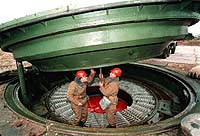
US arms inspectors must end their almost 15-year monitoring of Russia's main missile plant this week, as the key US-Russia nuclear treaty expires, a Russian military-diplomatic source said Tuesday.
Under the old Strategic Arms Reduction Treaty, or START, up to 30 US experts monitored traffic to and from Russia's foremost missile factory in the remote village of Votkinsk, about 580 kilometres (360 miles) northeast of Moscow.
"By December 5, when START expires, the team of US inspectors must fully dismantle their equipment and leave the Votkinsk factory," the source told Russian state news agency Interfax.
US and Russian negotiators have held frenetic talks in Geneva in recent months to thrash out a replacement for START, which imposes strict limits on the nuclear arsenals of the two former Cold War foes.
A major obstacle to a deal was eliminated in September when the US President Barack Obama's White House announced it was scrapping a plan to deploy a missile shield in eastern Europe, fiercely opposed by Russia.
But talks have reportedly hit a snag over the monitor missions to Russia.
Moscow wants to jettison any controls of its missile production under a new treaty, while Washington says monitoring is needed to ensure Russia complies with limits on the number of its nuclear-capable missiles.
"The situation under which the US inspectors conduct 24-hour controls on the activity of the Votkinsk factory cannot be seen as fair or balanced," the military source said.
"It would be inexpedient to transfer these terms to the new contract."
Russia views the US inspections as non-reciprocal because the US has no such plants producing mobile missiles for possible monitoring.
Moscow manufactures Topol-M and Bulava nuclear-capable intercontinental ballistic missiles at the plant.
START, signed in 1991 just before the break-up of the Soviet Union, bound both sides to deep cuts in their nuclear arsenals and to limits on long-range missiles.
At a Moscow summit in July, Obama and his Russian counterpart Dmitry Medvedev agreed to reduce their nuclear arsenal to between 1,500 and 1,675 warheads apiece within seven years.
They also agreed to cut the number of ballistic missile carriers to between 500 and 1,100.
Share This Article With Planet Earth
