
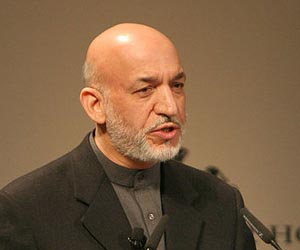
President Hamid Karzai warned Sunday that the US military must scale back operations and reduce "intrusiveness" into Afghan life or risk fueling the Taliban insurgency.
The comments, which appeared to contravene the US military's counter-insurgency strategy, were met with dismay from US lawmakers. They also put Karzai squarely at odds with US and NATO commander General David Petraeus, who has made capturing and killing militants a key priority.
Karzai said the presence of about 100,000 US troops and especially "terrible" night raids conducted by US forces on Afghan homes, inflame the emotions of everyday Afghans and lead angry young men to join the insurgency.
"The raids are a problem always. They were a problem then, they are a problem now. They have to go away," Karzai told The Washington Post in Kabul.
"The Afghan people don't like these raids, if there is any raid it has to be done by the Afghan government within the Afghan laws. This is a continuing disagreement between us."
Republican Senator Lindsey Graham, who met with Karzai this week as part of a congressional delegation, said he was "just stunned" by the president's remarks.
"We were briefed by our military commanders that the night raids… are making a huge impact on the Taliban, the insurgency as a whole," he told ABC television's "This Week."
He said the raids "didn't come up at all" during talks with Karzai.
"We talked about, quite frankly, looking long term with Afghanistan about having two air bases in a permanent fashion in Afghanistan to provide stability, so at the end of the day, there was no discussion about a difference between Petraeus and Karzai, in terms of strategy," Graham added.
Karzai said "the time has come to reduce military operations," a statement that runs counter to the US plan of intensifying military operations against the Taliban ahead of the start of a planned US military withdrawal in mid-2011.
He urged the US military to lighten its footprint in his country and shift toward a more civilian operation to "reduce the intrusiveness into the daily Afghan life."
US President Barack Obama has soft-pedaled on his plans to begin withdrawing troops next year, stressing instead his goal of handing over security to Afghans by 2014.
Graham, who serves on the Senate Armed Services Committee, said it was more realistic to wait another three years.
"The Petraeus strategy must be allowed to go forward for us to be successful. The security gains are obvious. We're not there yet, but we're moving in the right direction," he said.
"2014 is the right date to talk about. That's when Karzai suggests that Afghans will be in the lead, and I'm very pleased to hear President Obama talk about 2014."
Karzai suggested the United States should focus more intently on rooting out Taliban sanctuaries in neighboring Pakistan, and shift its emphasis in Afghanistan to development work.
Graham warned that ending the night raids would be a "disaster," in comments echoed by an unnamed NATO military official.
"We would not be as far along as we are pressuring the network had it not been for these very precision operations we do at night," the official told the Post.
"I don't see any near-term alternative to this kind of operation."
Karzai told The Washington Post he was speaking out not to criticize the United States but in the belief that candor could improve what he called a "grudging" relationship between the countries.
He acknowledged an abrupt withdrawal would be dangerous, but said US soldiers should be more confined to their bases and limit themselves to necessary operations along the Pakistani border.
earlier related report
Karzai wants US to reduce military operations: report
Washington (AFP) Nov 13, 2010 –
Afghan President Hamid Karzai said on Saturday that the United States must reduce the visibility and intensity of its military operations in Afghanistan, The Washington Post reported.
The United States should end special operations forces raids that aggravate Afghans and could exacerbate the Taliban insurgency, Karzai said in an interview with the Post.
"The time has come to reduce military operations," the president told the paper.
"The time has come to reduce the presence of, you know, boots in Afghanistan … to reduce the intrusiveness into the daily Afghan life."
Karzai also said he wanted US troops off the roads and out of Afghan homes and that the long-term presence of so many foreign soldiers would only worsen the war, the Post reported.
However, a unnamed NATO military official expressed skepticism in comments to the paper.
"We understand President Karzai's concerns, but we would not be as far along as we are pressuring the network had it not been for these very precision operations we do at night," the official told the Post.
"I don't see any near-term alternative to this kind of operation."
Karzai told the Post he was speaking out not to criticize the United States but in the belief that candor could improve what he called a "grudging" relationship between the countries.
He described his own deep skepticism with US policy in Afghanistan, beginning with last year's presidential election, which he said was manipulated by US officials, the paper said.
He also expressed his conviction that government corruption had been caused by billions of US dollars funneled to unaccountable contractors, the Post noted.
Afghans had lost patience with the presence of American soldiers in their homes and armored vehicles on their roads, Karzai told the paper.
"The raids are a problem always. They were a problem then, they are a problem now. They have to go away," Karzai said.
"The Afghan people don't like these raids, if there is any raid it has to be done by the Afghan government within the Afghan laws. This is a continuing disagreement between us."
He acknowledged that an abrupt withdrawal would be dangerous, but said that US soldiers should confine themselves more to their bases and limit themselves to necessary operations along the Pakistani border, the Post said.
Karzai said he wanted the US government to apply more pressure on Taliban sanctuaries in Pakistan while focusing on development projects and civilian assistance in Afghanistan, the report added.
Share This Article With Planet Earth
