
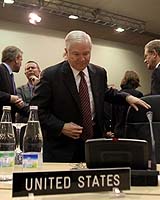
NATO defence ministers gathered Thursday to hear a United States appeal for more troops and equipment to confront a growing threat from Taliban insurgents in Afghanistan. US Defence Secretary Robert Gates will warn the ministers, during two days of talks in Seville, southern Spain, that time is running out to blunt the insurgency, with the Taliban likely to mount a new offensive in coming weeks.
Afghanistan's lawless border regions with Pakistan are a major haven for international terrorism, and the area where the Taliban militia have regrouped supplies much of the opium that reaches Europe and becomes heroin.
Yet despite repeated calls over several months by NATO commanders for more resources, the 26 member countries have appeared reluctant to put more of their forces in harm's way.
"We have taken a decision in NATO to do the job and all countries in NATO should provide soldiers," said Danish Defence Minister Soren Gade, whose country is providing 400 personnel, the most per capita of any member.
"If we do not send more soldiers to Afghanistan there is a risk that we might fail," he warned.
A senior US official travelling with Gates had the same message.
"We are saying to the allies all of us need to be prepared to blunt this and defeat it. And now is the time to stand up to the military necessity. Waiting isn't going to help us," he said.
"Now's the time to be ready to inflict a defeat on them, the offensive should be our offensive."
NATO's new military chief US General Bantz Craddock, who along with Gates faces a baptism of fire in his first official meeting, is to present the allies with a new list of military requirements for the NATO-led force in Afghanistan.
Craddock is expected to call for three more battalions for the 35,000-strong International Security Assistance Force (ISAF), which NATO has led since 2003 and which has assumed responsibility for security across Afghanistan.
Ahead of the talks, Germany said it planned to send six reconnaissance jets to Afghanistan, although not in a combat role, while Britain said it expects to have 800 more troops in place by the Afghan summer.
These offers came after a US proposal on January 26 to provide 10.6 billion dollars (8.2 billion euros) in aid over the next two years and keep more than 3,000 troops already in Afghanistan there for an extra four months.
The slowness shown by many allies has embarrassed NATO in past meetings, and before these talks officials insisted that the meeting here would not be about "force generation."
"Neither the secretary general nor General Craddock are going to be handing around the begging bowl looking for contributions," John Colston, NATO's assistant secretary general for defence policy and planning, said Tuesday.
Yet last month, Secretary General Jaap de Hoop Scheffer said: "Force generation will no doubt be discussed in Seville."
No one doubts that more troops are needed, and quickly.
Some 4,000 people were killed in the insurgency last year and US officials say suicide attacks have increased four-fold since 2005. In recent days, the Taliban held control of a town in southern Helmand province.
Officials on both sides of the Atlantic have insisted that 2007 is a decisive year to defeat the Taliban, ousted from power in late 2001 for harbouring Osama bin Laden, and push ahead with reconstruction.
If NATO fails to spread the influence of President Hamid Karzai's weak central government throughout the country and revive the economy, ordinary Afghans could turn back to the extremist Taliban.
"There is not a final military answer to Afghnistan. We need development, reconstruction, nation-building," Scheffer said after talks with the meeting's host, Spanish Defence Minister Jose Antonio Alonso.
earlier related report
Facts about the NATO-led security force in Afghanistan
Seville (AFP) Spain, Feb 8 – The NATO-led International Security Assistance Force (ISAF) in Afghanistan, topping the agenda of a meeting of alliance defence ministers Thursday, now comprises almost 35,500 troops.
More than half of the force, drawn from 37 nations, is made up of contributions from the United States, with 14,000 troops, and Britain, which has deployed 5,200 personnel, according to official figures released Wednesday.
Until NATO took command in 2003, the leadership of ISAF had rotated among different nations every six months.
NATO expanded its operations from Kabul and the relatively quiet north and west of the conflict-torn country, to the south and east, where a resurgent Taliban militia has opposed it.
The Taliban, ousted from power in late 2001 for harbouring Osama bin Laden, is expected to mount a new offensive in the south and east in coming weeks as the weather warms. Its fighters seized control of one town last week.
Britain, along with Canada — with 2,500 troops — and the Netherlands, 2,200, have born the brunt of the fighting in the Taliban's heartland in the south, and NATO commanders have urged the allies to inject more resources.
On the eve of the NATO meeting in Seville, Germany announced plans to deploy six reconnaissance jets — and the 500 personnel needed to run them — but it insists they will play no combat role.
Britain also announced that it would have an additional 800 troops in the south of the country by the Afghan summer. Poland has started deploying around 1,000 troops, which are likely to be in place by April.
NATO's new military chief, US General Bantz Craddock, is likely to urge the 26 alliance nations to come up with an additional three battalions, whose size differs from country to country but should mean about 3,000 personnel.
Officials say, though, that no new offers are likely to be made in Seville.
The ISAF operation — NATO's most ambitious mission ever — is aimed at spreading the influence of President Hamid Karzai's weak central government to the more lawless outlying regions.
The way it plays out could determine the future of the 60-year-old military alliance and whether its vocation involves combat operations, or more modestly just peacekeeping and reconstruction.
ISAF troop numbers fluctuate constantly as troops are deployed, rotated, replaced or simply withdrawn from the country.
Source: Agence France-Presse
