
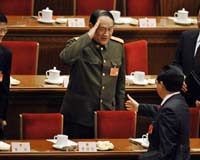
US Defense Secretary Robert Gates and his Chinese counterpart General Liang Guanglie used a new telephone hotline Thursday between the US and Chinese defense ministries for the first time, the Pentagon said.
Gates and Liang spoke to each other for about 30 minutes over the direct telephone link, said Major Stuart Upton, a Pentagon spokesman.
Upton said Gates used the call to urge China to work with the newly elected leaders of Taiwan, and reiterated that the United States opposes any unilateral effort by either China or Taiwan to change the status quo.
Liang pushed for an end to US-Taiwanese military relations, according to Xinhua, the official Chinese news agency, which cited a defense ministry statement. China regards Taiwan as a renegade province.
Gates congratulated Liang on his recent promotion to defense minister "and welcomed this important step forward in enhancing communications between our ministries," Upton said.
The spokesman said they discussed "building on the positive momentum in military-to-military relations, encouraging the trend of greater transparency at all levels in which substantive dialogue can help avoid miscalculation."
Liang said the direct telephone link was an important step that served both countries' long-term strategic interests, according Xinhua.
The direct telephone link between the US and Chinese defense ministries has taken years to establish despite periodic crises in military relations between the two powers.
US President George Bush and Chinese President Hu agreed to establish the hotline in September 2007, but a formal agreement between the two defense establishments was not signed until February 29.
earlier related report
China's military rise 'lacks transparency': US commander
Chinese efforts to assure the world of its "peaceful rise" are being contradicted by a lack of transparency about its military build-up, the top US military commander in the Pacific said Thursday.
China has failed to explain how the development of key weapons fit with its stated aim of becoming a great power without confrontation, US Pacific Command chief Admiral Timothy J Keating told reporters in the Indonesian capital.
"They (China) profess to seek a 'peaceful rise' and 'harmonious integration' and we're all for that. They have to show us how they intend to achieve that while developing these certain weapons," he said.
"And we think there is some contradiction between their stated role versus the practice, but we'll continue to work with them."
Keating, who was on an official visit to Indonesia, said he had raised his desire for more transparency from the Chinese on two visits to the country so far this year, but talks had been "not entirely fruitful."
"It's our clear purpose to draw them out, to engage with them, to offer them the opportunity to observe exercises on a multilateral basis, simple though they may be, so as to ensure they are aware of what it is we are about," Keating said.
Keating's comments come just over a month after the release of a Pentagon report that said China had boosted total military spending in 2007 to more than twice its declared budget.
The report raised concern over China's expanding military power, including its development of cruise and ballistic missiles capable of striking aircraft carriers and other warships at sea, anti-satellite weapons and intercontinental ballistic missiles.
China dismissed the Pentagon report as an exaggeration, made in order to justify US sales of military hardware to Beijing's rival Taiwan.
The Pentagon estimated China's total military spending in 2007 at between 97 and 139 billion dollars, more than double China's declared budget of 45 billion dollars.
