
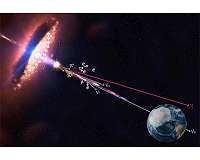
The signal recorded for the first time ever as a cosmic particle travelled nearly 4 meters through liquid argon, inside the newest detector to become operational at CERN, could help explain more about how the universe works and why matter exists at all.
Based on the Swiss/French border the experiment, ProtoDUNE, has included substantial contributions from UK scientists and engineers as they reach this latest milestone in an experiment aimed at unlocking the mysteries of neutrinos.
The UK is investing Pounds 65million in this flagship global science project that could change our understanding of the universe. The investment, made under a 2017 UK-US Science and Technology agreement, has enabled many UK groups to work on ProtoDUNE that is the prototype for the forthcoming USA based Deep Underground Neutrino Experiment (DUNE).
ProtoDUNE is the largest liquid-argon neutrino detector in the world and these first few particle detections signal the start of a new chapter in the story of DUNE.
Professor Dave Newbold from the University of Bristol and the Director of the STFC Particle Physics Department said of the breakthrough "The work of UK scientists has been crucial in bringing ProtoDUNE from the drawing board to reality in record time.
The delicate wire planes that are at the heart of the experiment, along with complex electronics needed to capture the data, were conceived, designed and built in labs across the UK. We're now confident in our technology as we begin construction of the full DUNE detector, which will be an even more challenging project"
DUNE's scientific mission is dedicated to unlocking the mysteries of neutrinos, the most abundant (and most mysterious) matter particles in the universe. Neutrinos are all around us, but we know very little about them.
Scientists on the DUNE collaboration think that neutrinos may help answer one of the most pressing questions in physics: why we live in a universe dominated by matter. In other words, why we are here at all.
Fabiola Gianotti, Director-General of CERN said "These first results from ProtoDUNE are a nice example of what can be achieved when laboratories across the world collaborate. Research with DUNE is complementary to research carried out by the LHC and other experiments at CERN; together they hold great potential to answer some of the outstanding questions in particle physics today."
The ProtoDUNE detector is the first of two prototypes for what will be a much, much larger detector for the DUNE project, hosted by the U.S. Department of Energy's Fermi National Accelerator Laboratory in the United States. When the first DUNE detector modules record data in 2026, they will each be 20 times larger than these prototypes.
The first ProtoDUNE detector took two years to build and eight weeks to fill with 800 tons of liquid argon, which needs to be kept at temperatures below -184 degrees Celsius (-300 degrees Fahrenheit).
The detector records traces of particles in that argon, from both cosmic rays and a beam created at CERN's accelerator complex. Now that the first tracks have been seen, scientists will operate the detector over the next several months to test the technology in depth.
