
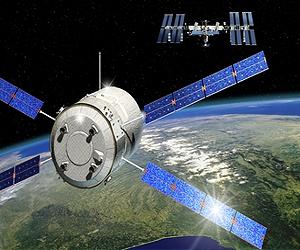
Rendezvous and docking in orbit is tricky. Take a huge, complex target like the International Space Station, and the task becomes even trickier.
The problems of getting spacecraft to dock with ISS has been highlighted often in recent years. There are issues with the reliability of new or modified vehicles, as well as traffic control problems with the Shuttle and other spacecraft going to ISS at the same time.
It's ironic. We've been doing rendezvous and docking for decades, but it now seems more difficult than ever.
There are basically two ways of getting a spacecraft to the ISS. It can be fairly sophisticated, flying to a controlled docking with one of the station's ports. It can also adopt the "valet parking" model, flying to close proximity with the station, then being captured by a robot arm.
There will be new spacecraft and new space stations in the future. The problems that have been highlighted by operations at the International Space Station will not go away. It's time to explore rendezvous, docking and traffic control issues in greater depth.
There's a need for some more work on this within engineering circles. Some of these problems will be solved as new spacecraft prove their reliability, and as new technology makes rendezvous and docking easier.
Procedures and management also need to be examined. Too many missions have had their launch times altered because of management issues with other spacecraft. Some of these issues could have been anticipated long before the original launch times were specified.
It's clearly time for a fresh look at a lot of these issues. There's one idea that needs to be re-examined for the future. We should consider the introduction of .
Orbital transfer vehicles have been discussed for a long time, but they have never really been employed to much effect. Sure, there are booster stages for satellites that have already reached orbit, and boosters for payloads lofted by the Space Shuttle. But we could certainly do with a more sophisticated type of spacecraft.
A true space tugboat could rendezvous and dock with a spacecraft in orbit, then transfer it to a safe rendezvous and docking with a space station.
In such a scenario, the space tugboat could be expected to feature radar, lidar and transponders to handle the docking. In some cases, it will be the tugboat itself that makes direct physical contact with a docking port on the space station. The tugboat could also carry fuel and engines to help the new spacecraft reach a space station in a higher orbit.
A plan such as this would take out some of the uncertainty and risks associated with rendezvous and docking. A reliable tugboat could be trusted for a docking run, even if the spacecraft it is carrying is unproven.
The use of some rendezvous apparatus on the tugboat could remove the need for some of this equipment on the carried spacecraft, simplifying costs and design. The tugboat itself would be re-useable, even if the carried spacecraft were not.
A tugboat could also serve as an adapter for different docking systems. Various tugboats could be built to allow spacecraft with different docking systems to dock with a variety of docking ports at different stations. The variety of docking interfaces already found on the International Space Station highlights this problem.
Yes, this is hardly a new concept, but it seems to be an idea that needs to be re-examined. Recent events have shown that we need to consider how to manage frequent dockings of multiple vehicles with different designs. Spaceflight is expected to become more active in the future.
The tugboat will not be needed for all, or even most docking scenarios. But it should be considered as a useful option for some operations. A tugboat could solve some problems, and stop those problems cascading into further issues for an entire space station.
Share This Article With Planet Earth
