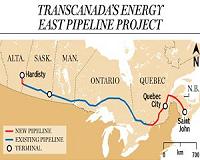
TransCanada announced Thursday it was abandoning its bid to build an east-west pipeline that would have moved crude from Alberta's oil sands to refineries on Canada's Atlantic coast.
The 4,500-kilometer (2,800-mile) Energy East pipeline, which would have carried 1.1 million barrels of oil per day, had presented an opportunity to wean Canada off foreign oil as refineries in eastern Quebec and New Brunswick rely mostly on imports.
But it faced stiff opposition from environmental groups and several municipalities in Quebec concerned about possible spills affecting groundwaters and rivers along its path.
"After careful review of changed circumstances, we will be informing the National Energy Board that we will no longer be proceeding with our Energy East application," company chief executive Russ Girling said in a statement.
The project — involving the conversion of a natural gas conduit from Alberta to Quebec and the construction of new pipes on the last leg to New Brunswick — was first proposed in 2013 when oil prices were near US$100 per barrel.
But as prices tumbled and regulatory hurdles aimed at protecting the environment multiplied, the business case for Energy East became weaker.
During a lengthy consultation process, tweaks to the Can$16 billion (US$13 billion) project were made to try to appease critics, including the scrapping of a marine terminal that would have created an opportunity to export oil to Europe but negatively impacted beluga whale calving grounds in the Saint Lawrence River.
In the end environmental concerns trumped potential economic gains.
Conservative MP Lisa Raitt blamed Prime Minister Justin Trudeau's tightening of regulations requiring downstream oil and gas greenhouse gas emissions to be considered as part of the approvals process for new energy projects.
These new rules are "onerous" and have created an uneven playing field with foreign oil companies, she said.
– 'Disastrous energy policies' –
"Today's announcement is not the result of a sudden decision by TransCanada. Instead, today is a result of the disastrous energy policies promoted by Justin Trudeau and his failure to champion the Canadian energy sector," Raitt said.
"Everything Justin Trudeau touches becomes a nightmare."
Natural Resources Minister Jim Carr, however, rejected her criticisms, calling TransCanada's move a "business decision" and pointing to the Liberal government's approval of two other pipelines under a similar set of criteria.
"While we recognize the current market challenges related to lower commodity prices, we are seeing signs of growth in the sector," he said.
New Brunswick Premier Brian Gallant went further in saying he believed the project would have been approved if TransCanada had continued with the process.
While Alberta premier Rachel Notley and business associations also lamented its demise, environmental groups and Quebec leaders rejoiced and praised citizen groups that played a key role in the fight against the pipeline.
The project's cancellation is a "serious blow to the Canadian economy," as it would have created thousands of jobs, said Chamber of Commerce president Perrin Beatty.
"The world is changing and the end of the oil era is in sight," countered Greenpeace's Patrick Bonin.
Cancelling the Energy East project will cost TransCanada Can$1 billion, but allow the company to refocus resources on its Keystone XL project to move Alberta oil to refineries in the US Gulf Coast. The project is awaiting approval from the US state of Nebraska.
Last November, before US President Donald Trump gave a green light for Keystone XL, Ottawa agreed to allow Kinder Morgan to triple the capacity of its Trans Mountain pipeline from Alberta to the Pacific Coast and Enbridge's Line 3 to the United States.
At the same time, Ottawa rejected a third proposal to build a new pipeline across British Columbia's temperate rainforest.
Those decisions, along with stepped up Pacific marine protections and emergency responses to oil spills, were seen as a compromise to diversify markets for landlocked Alberta's abundant oil while acknowledging environmental perils.
The Trans Mountain project, however, continues to face pushback, with a coalition of indigenous tribes, environmental groups, municipalities and the new British Columbia government going to court last Monday to try to stop its construction.
amc/jm
TransCanada
Shell defends divestment efforts, but cancels sale in Thailand
While defending a robust spending program, Royal Dutch Shell said Wednesday it was canceling an agreement to sell off a stake of its assets in Thailand.
Subsidiaries of Shell and the Kuwait Foreign Petroleum Exploration Co. said they mutually agreed to cancel the multilmillion dollar sale of shares in Shell Integrated Gas Thailand Pte. Ltd., known also as SIGT, and Thai Energy Co Limite … read more