
Japanese firm Toyota expects a sharp increase in sales of hybrid cars to more than 1.0 million a year early in the next decade, Toyota Europe Vice President Thierry Dombreval said on Tuesday. "Over the next few years we plan to double our global hybrid vehicle offering, anticipating annual sales of over 1.0 million hybrid vehicles early in the next decade," Dombreval said at the Geneva Motor Show.
The world's number two carmaker said in December that it expected global production of 9.42 million of all types of vehicles in 2007.
Including luxury Lexus brand models, Toyota says its overall hybrid sales worldwide are nudging the 900,000 mark since its first hybrid compact model was launched a decade ago.
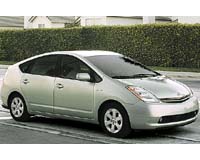
The Japanese firm, which pioneered mass production of the low pollution petrol-electric vehicles along with Honda, has sold 650,000 of its compact hybrid Prius worldwide since 1997.
Just 50,000 of them have been sold in Europe. By comparison, overall sales of the whole of the company's brands reached 1,12 million in Europe in 2006.
The company displayed prototypes of two new hybrid models in Geneva, including a roomier version aimed at families, and a 400 horsepower concept sports car.
Hybrids have formed the backbone of the Japanese company's ecology-friendly planning so far, along with cleaner burning petrol and diesel engines.
Some manufacturers in Geneva are looking at a wider range of alternatives including biofuels and hydrogen.
Toyota President Katsuaki Watanabe said in Geneva that the company was not aiming to buy the US third largest carmaker Chrysler from DaimlerChrysler.
earlier related report
GM says EU emissions targets a 'stretch'
Geneva (AFP) March 6 – General Motors President Rick Wagoner on Tuesday said that new emissions targets the European Union is preparing to impose would prove to be a "stretch" for the world's biggest carmaker. "GM supports the goal of reducing CO2 (carbon dioxide) emissions. Although the Commission's current proposal is a significant stretch, we're working hard to do our part," the head of the ailing car giant said at the opening of the Geneva Motor Show.
Under a European Commission proposal unveiled last month, car manufacturers would be required to limit engine emissions to an average of 130 grammes of carbon dioxide per kilometre across their fleet within five years to combat climate change.
Currently they face a voluntary target of 160 grammes, which most carmakers say they are going to miss.
"Ultimately we believe that environmental goals can be accomplished most effectively with an integrated approach that engages automakers, fuel providers, governments and consumers," Wagoner said at a GM press launch here.
The controversial Commission targets, which still have to be endorsed by the 27 member states later this year, were the subject of heavy bargaining.
EU Industry Commissioner Guenter Verheugen clashed with Environment Commissioner Stavros Dimas over how much of an effort should come from carmakers.
Dimas had sought a tougher binding limit of 120 grammes for carmakers while Verheugen wanted measures to be shared with tyre, equipment and fuel makers.
Wagoner indicated Tuesday that he wanted to see more support from the European Commission for cleaner ethanol produced from crops or vegetable matter.
"We look to European Commission to help create a strong policy framework to develop the E85 infrastructure," Wagoner said.
E85 is the most readily available biofuel that can be used in slightly modified existing engine technology, blending 85 percent of ethanol with 15 percent of petrol.
GM underlined that a range of alternative fuels — ethanol, hydrogen and electricity — as well as a more efficient traditionally fuelled cars, would underpin its recovery from massive financial trouble in recent years.
"In 2007, we'll stay focused on moving from turnaround to transformation … and a key element of our strategy is our drive for environmental and technology leadership," Wagoner said.
Source: Agence France-Presse
