
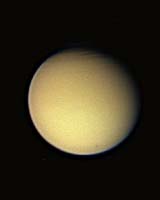
This new view of Titan reveals structure in the moon's complex atmosphere. The geometry of the Cassini spacecraft's view of Titan during this flyby was similar to that of Voyager 1's pass in 1980.
The view has been greatly contrast-enhanced and shows intriguing structure in the north of Titan (5,150 kilometers, or 3,200 miles across) that is also clearly visible in a violet light view taken at about the same time.
Mission scientists created the color view by combining images taken using red, green and blue spectral filters. Cassini captured the images with its wide-angle camera on Dec. 26 at a distance of approximately 193,000 kilometers (120,000 miles) and at a Sun-Titan-spacecraft – or phase – angle of 29 degrees. The image scale is 11 kilometers (7 miles) per pixel.
The Cassini-Huygens mission is a cooperative project of NASA, the European Space Agency and the Italian Space Agency. The Jet Propulsion Laboratory, a division of the California Institute of Technology in Pasadena, manages the mission for NASA's Science Mission Directorate, Washington, D.C. The Cassini orbiter and its two onboard cameras were designed, developed and assembled at JPL. The imaging operations center is based at the Space Science Institute in Boulder, Colo.
