
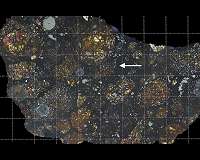
A tiny piece of the building blocks from which comets formed has been discovered inside a primitive meteorite. The discovery by a Carnegie Institution of Science-led team, including a researcher now at Arizona State University, was published April 15 in Nature Astronomy.
The finding could offer clues to the formation, structure, and evolution of the solar system.
"The meteorite is named LaPaz Icefield 02342," says research scientist Jemma Davidson of ASU's Center for Meteorite Studies in the School of Earth and Space Exploration. "The name comes from where it was found in Antarctica's LaPaz Icefield."
She adds that it belongs to a class of primitive carbonaceous chondrite meteorites that have undergone minimal changes since they formed more than 4.5 billion years ago, likely beyond the orbit of Jupiter.
Construction debris
Meteorites were once part of larger bodies, asteroids, which broke up due to collisions in space and survived the trip through Earth's atmosphere. Their makeup can vary substantially from one meteorite to the next, reflecting their origins in diverse parent bodies that formed in different parts of the solar system.
Asteroids and comets both formed from the disk of gas and dust that once surrounded the young Sun, but they aggregated at different distances from it, which affected their chemical makeup. Compared to asteroids, comets contain larger fractions of water ice and far more carbon, and typically formed farther from the Sun where the environment was colder.
By studying a meteorite's chemistry and mineralogy, researchers such as the paper's lead author, Carnegie's Larry Nittler, can unlock details about its formation and how much heating and other chemical processing it experienced during the solar system's formative years.
'Bonbon' with a surprise inside
Inside the LaPaz meteorite, Nittler's team found a very carbon-rich slice of primitive material. It bears some striking similarities to extraterrestrial dust particles that are thought to have originated in comets that formed near the solar system's outer edges.
Approximately 3 to 3.5 million years after the solar system formed, but while Earth was still growing, this tiny object – about one tenth of a millimeter across – was captured by the growing asteroid from which the meteorite originated.
"Primitive meteorites provide a snapshot of the early solar system that we can study in the lab," says Davidson. "The LaPaz meteorite is a nice example since it has experienced minimal terrestrial weathering."
Meteorites like LaPaz, she notes, are great places to hunt for presolar grains, microscopic pieces of stardust formed by stars that predate the solar system. But none of the team expected also to find evidence for a surviving cometary building block inside a meteorite.
Ancient survivor
"When Larry and Carles showed me the first electron images of the carbon-rich material," Davidson says, "I knew we were looking at something very rare. It was one of those exciting moments you live for as a scientist."
By undertaking sophisticated chemical and isotopic analysis of the material, Nittler and his colleagues – who besides Davidson include Carnegie's Conel Alexander as well as Rhonda Stroud and Bradley De Gregorio of the U.S. Naval Research Laboratory, and Josep Trigo-Rodriguez, Carles Moyano-Cambero, and Safoura Tanbakouei of the Institute of Space Sciences in Barcelona, Catalonia – were able to show that the encased material likely originated in the icy outer solar system along with objects from the Kuiper Belt, where many comets originate.
"Because this sample of cometary building block material was swallowed by an asteroid and preserved inside this meteorite, it was protected from the ravages of entering Earth's atmosphere," Nittler explains. "It gave us a peek at material that would not have survived to reach our planet's surface on its own, helping us to understand the early solar system's chemistry."
The existence of this primitive material captured inside the meteorite suggests that due to the drag caused by the surrounding gas, particles like it migrated from the outer edges of the solar system, where comets and Kuiper Belt objects formed, to the closer-in area beyond Jupiter, where the carbonaceous chondrites formed. This reveals details about how our solar system's architecture took shape during the early stages of planet formation.
"Discoveries like this demonstrate how important it is to retrieve precious meteorites like LaPaz from Antarctica," says Davidson. "We never know what secrets they'll reveal."
Carnegie Institution for Science
Cometary surprise found inside meteorite
Washington DC (SPX) Apr 16 – An ancient sliver of the building blocks from which comets formed was discovered encased inside a meteorite like an insect in amber by a Carnegie-led research team. The finding, published by Nature Astronomy, could offer clues to the formation and evolution of our Solar System.
Meteorites were once part of larger bodies, asteroids, which broke up due to collisions in space and survived the trip through the Earth's atmosphere. Their makeup can vary substantially from meteorite to meteorite, reflecting their varying origin stories in different parent bodies that formed in different parts of the Solar System.
Asteroids and comets both formed from the disk of gas and dust that once rotated around our young Sun, but they aggregated at different distances from the Sun, affecting their chemical makeup. Compared to asteroids, comets contain larger fractions of water ice and far more carbon.
By studying a meteorite's chemistry and mineralogy, researchers like the paper's lead author, Carnegie's Larry Nittler, can reveal details about its formation and how much heating and other chemical processing it experienced during the Solar System's formative years.
A particularly primitive class of meteorites called carbonaceous chondrites are thought to have formed beyond Jupiter. One such meteorite, discovered in Antarctica's LaPaz Icefield, is a particularly pristine example with minimal weathering since its landing on Earth's surface.
Inside the LaPaz meteorite, Nittler's team found a very carbon-rich slice of primitive material that bears some striking similarities to extraterrestrial dust particles that are thought to have originated in comets that formed near the Solar System's outer edges. Approximately 3-3.5 million years after the Solar System formed, but still long before Earth finished growing, this object – about one tenth of a millimeter across – was captured by the growing asteroid from which the meteorite originated.
By undertaking sophisticated chemical and isotopic analysis of the material, Nittler and his colleagues – Carnegie's Conel Alexander and Jemma Davidson (who is now at Arizona State University), as well as Rhonda Stroud and Bradley De Gregorio of the U.S. Naval Research Laboratory, and Josep Trigo-Rodriguez, Carles Moyano-Cambero, and Safoura Tanbakouei of the Institute of Space Sciences in Barcelona, Catalonia – were able to show that the encased material likely originated in the icy outer Solar System along with objects from the Kuiper Belt, where many comets originate.
"Because this sample of cometary building block material was swallowed by an asteroid and preserved inside this meteorite, it was protected from the ravages of entering Earth's atmosphere," Nittler explained. "It gave us a peek at material that would not have survived to reach our planet's surface on its own, helping us to understand the early Solar System's chemistry."
The existence of this primitive material inside the meteorite indicates that due to the drag caused by the surrounding gas, particles like it migrated from the outer edges of the Solar System, where comets and Kuiper Belt objects formed, to the closer-in area beyond Jupiter, where the carbonaceous chondrites formed, revealing details about how our Solar System's architecture was shaped during the early stages of planet formation.
Spanish National Research Council
Comet fragment discovered inside meteorite gives clues to the origin of the solar system
Madrid, Spain (SPX) Apr 16 – An international team including researchers from the Institute of Space Studies of Catalonia at the Institute of Space Sciences (Spanish National Research Council-CSIC) has discovered a pristine comet fragment inside a meteorite.
This finding demonstrates that the class of meteorites known as carbonaceous chondrites contains clues to the composition of more fragile objects that formed in regions distant from the Sun, more than 4,560 million years ago. The results are published in the journal Nature Astronomy.
After a three-year study of the carbonaceous chondrite La-Paz 02342, from NASA's Antarctic collection, researchers have come to the conclusion that the comet fragment, of about one hundred microns, is composed of an unusual mixture of organic materials, amorphous and crystalline silicates, sodium sulphates, sulphides, and presolar grains; the latter synthesised in stars that enriched the original materials of our Solar System.
Among other instruments, a secondary ion mass spectrometer (nano-SIMS) of the Carnegie Institution for Science (USA) has been used for its analysis, has been used for its analysis, which allows studying at a nanometric scale the composition of the meteorite at an isotopic and elemental level.
"This fragment, technically known as xenolith, has unusual characteristics that we think were produced from the incorporation of primitive materials embedded in ice", says IEEC-CSIC researcher Josep Maria Trigo-Rodriguez, who works at ICE and co-leads the study.
"Many objects in the Solar System have a very different composition than the meteorites available in terrestrial collections. Carbonaceous chondrites, such as La Paz 02342, constitute a fossil legacy of the creation of the planetesimals in their interior and are capable of preserving unique samples of other objects much richer in organic and volatile matter, known as comets", explains Trigo-Rodriguez.
As the researcher points out: "The asteroid progenitor of this carbonaceous chondrite underwent aqueous alteration, but fortunately, it was neither extensive nor homogeneous. This led to the preservation of the unique properties of this cometary dust speck, among which the richness in tiny mineral grains formed in stars of the same environment in which the Sun was born."
The most primitive meteorites
Carbonaceous chondrites come from transitional bodies, a category falling between asteroids and comets. Given their sizes typically smaller than a few hundred kilometres, such bodies never melted or suffered internal chemical differentiation as occurred to the planets.
The materials that make up these objects are usually fragile and do not usually survive the transit of tens of millions of years that transport them from their parent bodies to the Earth orbit.
In case they do, they fragment and volatilise when entering into the atmosphere at hypersonic velocities. Precisely because of this reason, ultracarbonaceous materials such as those discovered are extremely rare and have only been identified as micrometeorites.
The search for primordial materials among the most primitive meteorites can be carried out at ICE, given that it is the only international repository of NASA's Antarctic meteorites in Spain.
The samples studied by the IEEC-CSIC scientific team come from NASA's Johnson Space Center. Hence, researchers have access to unique specimens, being able to select those that have not undergone thermal metamorphism or extreme aqueous alteration.
