
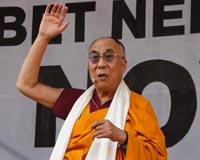
Sixty years after the Dalai Lama fled into permanent Indian exile, the cause of Tibetan freedom that earned him a Nobel prize and a celebrity-studded international following has lost much of its momentum — neutralised, analysts say, by the passage of time and China's rising global power.
Inside Tibet, Beijing has effectively wiped out any organised opposition to its iron-clad rule, while outside, the once-vocal support of sympathetic governments and world leaders has dwindled to near-silence in recent years despite the 14th Dalai Lama's enduring personal popularity.
"The fate of Tibet is in the hands of the Chinese state… Tibetans outside the region are not very relevant to the fate of Tibet, and this includes the Dalai Lama", said Nathan Hill, convener of Tibetan studies at the School of Oriental and African Studies (SOAS) in London.
In 2007, the Buddhist spiritual leader said his homeland was facing its "darkest period in 2,000 years". The following year, with the world's eyes on China in the run-up to the 2008 Olympics, protests unfurled across Tibet, sparking a furious response from Beijing.
"You don't see protests like that anymore," said Kate Saunders of the US-based International Campaign for Tibet, attributing the shift in part to Tibetans abiding by the Dalai Lama's message of non-violence and to massive Chinese state surveillance.
Although the Dalai Lama's campaign largely focused on autonomy rather than independence, negotiations with China stalled in 2010, amid suspicion that Beijing was intentionally dragging on pointless talks, hoping international pressure would ease with his eventual death.
The 83-year-old has sought to pre-empt any attempt by Beijing to name his reincarnated successor, even announcing in 2011 that he may be the last in the lineage.
The officially atheist Communist Party has already shown it will intervene in the reincarnation of important figures in Tibetan Buddhism, such as the Panchen Lama who traditionally plays a significant role in choosing the Dalai Lama's successor.
The boy chosen by the Dalai Lama to serve as the Panchen Lama was detained by Chinese authorities at the age of six and has not been seen since, with Beijing appointing its own candidate in 1995.
Although the exiled leader remains a hugely popular speaker, he has cut back on his global engagements and has not met a world leader since 2016 — while governments have been wary of extending invitations to him for fear of angering Beijing.
"The craze for Tibet among Westerners in the 1980s and the following decades has decreased significantly", said Katia Buffetrille, a Tibetologist at the Ecole Pratique des Hautes Etudes in Paris.
Even India, which offered asylum to the Dalai Lama in 1959 when he made a daring escape across the Himalayas dressed as a soldier, has turned its back, with the government reportedly warning officials against attending events featuring him, citing diplomatic sensitivities.
– Buying freedom –
As the exile-led movement loses momentum, Tibetans at home are struggling to keep their traditions alive.
"Tibetans live in a totalitarian police state — if they challenge restrictions, they face the consequences," said Gray Tuttle, a professor of modern Tibetan studies at Columbia University.
"Previous protests from the 1980s on… have yielded no tangible benefits, rather they have generated a worse political outcome and further clampdown."
At least 150 Tibetans have set themselves on fire since 2009 in protest against Beijing, most of whom have died from their injuries. But the frequency of self-immolations has lessened.
China's investment in the region includes a huge outlay on security to build a surveillance state that makes it harder to organise protests. Rights groups say that a government campaign targeting the family and friends of protesters has also helped suppress dissent.
Beijing insists that Tibetans enjoy extensive freedoms and argues it has brought economic growth to the mountainous region.
The oppression of Uighurs in Xinjiang has also overtaken Tibet as the focus of China's human rights critics.
When Germany's top human rights official Barbel Kofler asked to visit Xinjiang last year, she was taken instead to Tibet — an indication of how much Beijing feels secure about the situation there, even though foreign journalists are still barred from reporting independently in the region.
Many locals accuse Beijing of repressing their religion and diluting their culture, but nonetheless the economic growth — boosted by government subsidies — has even seen Tibetan exiles return to the region.
Tibetologist Francoise Robin, who visits the region every year, told AFP that Beijing had effectively sidelined any talk of freedom by pumping money into Tibet.
"This is what is paradoxical in the case of Tibet, compared to other similar situations, because China is a country… that is on the rise. Often, in order for a rebellion, for a mass movement to rise, you need economic despair."
60 years ago the Dalai Lama escapes China-ruled Tibet
Paris (AFP) March 15, 2019 –
In March 1959 Tibet's ruler and spiritual leader, the Dalai Lama, fled his homeland amid a deadly Chinese crackdown, escaping to India in a gruelling two-week trek.
There he would form a government-in-exile and demand autonomy for Tibet, going on to earn international renown and respect while remaining a bete noir for China.
Here is an account of his dramatic escape.
– Tibetans revolt against Chinese –
Buddhist Tibet, a vast Himalayan area of plateaus and mountains, declared independence from China in the early 20th century.
But China took back control in 1951, having sent in thousands of troops.
Lhamo Dhondup, chosen at the age of two in 1937 as the 14th incarnation of Tibetan Buddhism's supreme religious leader under the name Tenzin Gyatso, was enthroned as head of state after the Chinese invasion.
His co-existence with the Beijing authorities was tense and when the Chinese authorities summoned him to an event without his bodyguards on March 10, Tibetans feared a trap that could endanger their leader.
Thousands assembled at his summer palace to prevent him from leaving; thousands more demonstrated in Lhasa to demand the Chinese depart, the Dalai Lama would later say.
Beijing poured more troops into Tibet: as tensions mounted, they opened fire on March 17, targeting and eventually razing the Dalai Lama's palace.
The revolt was suppressed by March 21, ending in a bloodbath. The government in-exile later claimed the Chinese army killed tens of thousands.
– Dalai Lama disappears –
The outside world was largely unaware of the turmoil engulfing isolated and remote Tibet. Only neighbouring India had diplomatic representation there and rare reports of the unrest trickled out via its media.
On March 22 AFP reported from India that there was concern over the fate of the Dalai Lama, then aged 23, who seemed to have disappeared.
"According to some rumours, the young man could be in his Lhasa palace or under Chinese military guard," the report said, citing India's The Statesman newspaper.
It later emerged that he had been able to slip past Chinese troops massed around his palace on March 17, another AFP story said.
– A great escape –
He left the palace dressed as a soldier and met up with a group of Tibetan resistance fighters 60 kilometres (37 miles) out of Lhasa, AFP reported, again citing The Statesman.
His entourage included his mother, sister, younger brother and several top officials.
They travelled for two days and two nights without stopping, on foot and on horseback, AFP later cited a Tibetan official as saying.
A month's supplies were carried by mules. To cross the major 457-metre-wide (1,500-foot) Brahmaputra river, they used a single boat made of yak skin, the official said.
The group then continued on foot, walking only at night through the harsh Himalayan terrain.
They had a head start on Chinese troops who had not realised the Dalai Lama had disappeared until two days later, only then sending out a ground and air dragnet, and combing monasteries where he could be hiding.
It was "one of the most fantastic escapes in history", an AFP story said.
– Arrival in India –
On March 31 the Dalai Lama walked across the border into the Indian state of Assam.
"The Dalai Lama entered India on March 31 in the evening," Prime Minister Jawaharlal Nehru announced on April 3, AFP sending out the information in a top priority flash.
In mid-April an official statement provided details of his escape. "It is thanks to the affectionate support and the loyalty of his people that the Dalai Lama was able to make his way, by an extremely difficult route," it said.
It denied a Chinese claim that he had been forced into exile.
"The Dalai Lama wishes to categorically state that he left Lhasa and Tibet and came to India of his own free will and not by force", it said.
– Government-in-exile –
India granted the Tibet leader asylum on April 3 and permission to establish a government-in-exile in the northern hill station of Dharamsala, already a sanctuary for thousands of Tibetan exiles fleeing Chinese repression.
From there he launched a campaign to reclaim Tibet, gradually easing this into an appeal for greater autonomy.
Talks between the two sides failed, China adamantly rejecting any suggestion of Tibetan autonomy and blacklisting the Dalai Lama a dangerous "separatist".
Beijing continues to be accused of political and religious repression in the region, but insists Tibetans enjoy extensive freedoms and that it has brought economic growth.
More than 150 Tibetans have set themselves on fire since 2009 in protest against Beijing's presence in Tibet, most of them dying.
The Dalai Lama, who gave up his political role in 2011 but remains based in Dharamsala, has gained worldwide respect for his pacifist approach, winning the Nobel Peace Prize in 1989.
