
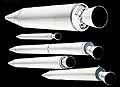
The U.S. Department of State has issued an export license to Thiokol Corporation's Propulsion Group in Brigham City, Utah, to provide CASTOR IVB solid rocket motors to the Instituto Nacional de Technica Aerospacial (INTA) of Spain. The CASTOR IVB rocket motors will be used as the first stage for the three stage Capricornio launch vehicle currently under development by INTA. This launch vehicle is intended to place small scientific payloads and communication satellites into low earth orbit. The first Capricornio vehicle is scheduled to launch a University of Madrid communications satellite in the year 2000.
The CASTOR IVB is a rocket motor similar to the CASTOR IVA rocket motor
used on the Lockheed Martin Atlas IIAS launch vehicle except with a moveable nozzle. It was originally developed by Thiokol's Huntsville Division in the late 1980's as a propulsion system for Germany's Daimler-Benz Aerospace MAXUS program and was approved for export. The MAXUS is a sub-orbital launch vehicle used for micro-gravity experiments launched by the Swedish Space Corporation from Kiruna, Sweden, 60 kilometers north of the Arctic Circle. The next flight of the MAXUS vehicle is scheduled for late 1998.
The issuance of the Spanish export license is another significant
milestone in Thiokol's expanding involvement in international markets. This is the first export license granted by the Department of State to allow Thiokol to conduct business in Spain. Grady L. Jacobs, Director of
Contracts for the Propulsion Group, said “Thiokol is very pleased to be given this opportunity to support the Spanish space program. This program will enable us to add the Castor IVB to our family of rocket motors now produced in northern Utah.''
Thiokol also possesses Department of State licenses to export technology
for the development of the SRB-A rocket motor case being produced by Japan and for the CASTOR IVA-XL solid rocket motor currently under development for use on Japan's H-IIA launch vehicle.
The contract with INTA requires the initial delivery of two CASTOR IVB
solid rockets in the fall of 1999. An inert Pathfinder motor will be
delivered in 1998 to allow the Spanish to practice motor handling procedures and equipment associated with the processing of the system.
Background
In 1992 Spain's National Institute for Aerospace Technology (INTA) announced plans to develop a small orbital launch vehicle
with a payload capacity of up to 100 kg into 600 km polar orbits. Named Capricornio, the launch vehicle is still in the
preliminary design stage, although an initial flight in this decade is desired. To facilitate the development effort, INTA will
produce the solid-propellant second stage and purchase a foreign-made solid propellant first stage. The third stage may be
either foreign or domestic, liquid- or solid-fueled, although a foreign solid-propellant stage is the leading candidate. The initial
launch site may be El Aranosillo near Portugal to be followed by a more capable launch facility in the Canary Islands. Despite
funding reductions and schedule delays, the Capricornio program was still officially on-going at the end of 1994. Meanwhile,
near-term launch needs for Spain's Minisat program will probably be met by the US' Pegasus or ESA's Ariane launch vehicles.
source: World Space Guide
