
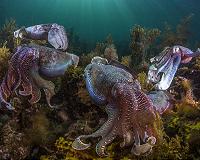
Unlike squid, bottom-dwelling cuttlefish may be able to put one key aspect of their camouflage on autopilot. Marine Biological Laboratory and University of Cambridge researchers report that these cephalopods can lock in the 3-D textured shape of their dynamic skin for over an hour without nervous system input. This physiology is thought to help cuttlefish save energy as they camouflage from predators, wait for prey, or digest food. The study appears February 15 in iScience, a newly launched interdisciplinary journal published by Cell Press.
"I just couldn't believe that I cut the pallial nerve, and the papillae – the bumps of skin that allow cuttlefish to change the texture of their skin to become more rock- or kelp-like – stayed intact," says first author Paloma Gonzalez-Bellido, a lecturer in neuroscience at the University of Cambridge. "We know that papillae are formed by a complex array of muscles. The only way that these muscles can actually stay coordinated in these complicated shapes without any neural input is that they have a way to hold tension."
This mechanism hasn't been observed in other cephalopods, such as squid or octopus, but it is known that bivalve molluscs clamp shut their shells using catch muscles to save energy. Although what's happening in the cuttlefish is more complex, the researchers are curious to find out whether this is a case of independent evolution, as the main neurotransmitters that signal bivalve catch muscles also control papillae expression.
Gonzalez-Bellido made this discovery while investigating cuttlefish camouflage control at the Marine Biological Laboratory with colleagues Trevor Wardill, Roger Hanlon, and Alexia Scaros. They were interested in tracing what happens in the cuttlefish nervous system that allows the animal, based on visual signals alone, to contract its skin and change its 3-D texture in a matter of seconds.
"We've known about papillae for some time, but generally people have been studying them from more of a behavioral perspective, and we got involved to look at how skin operates and followed up with a neurobiology approach," says Wardill (@trevorwardill), a neuroscientist at the University of Cambridge.
In addition to identifying the motor neurons and neurotransmitters dedicated exclusively to camouflage control, the researchers found remarkable similarity between the nerves that control the cuttlefish papillae and the neural circuit for iridescence in some squid. This is the ability of squid to change how the sun's light reflects off of their bodies in such a way that it hides them from predators and prey or to send signals to conspecifics. Cuttlefish do not have tuneable iridescent skin.
"The similarities between papillae and iridescence control make us think the two systems evolved from a skin neural circuit already present in a common ancestor, although it would require a lot more study to know for sure," Wardill says.
The researchers now aim to explore this link and the diversity of iridescence and papillae control among squid and cuttlefish. They also want to understand why the motor neurons are located in peripheral ganglia, positioned between the brain and the skin.
"We can learn so much from these animals," says Gonzalez-Bellido. "They have really developed brains despite only living one or two years, so it's a unique opportunity to figure out how evolution may have come up with a completely different nervous system from ours."
How the cuttlefish spikes out its skin: Neurological study reveals surprising control
Woods Hole MD (SPX) Feb 16 – Wouldn't it be useful to suddenly erect 3D spikes out of your skin, hold them for an hour, then even faster retract them and swim away? Octopus and cuttlefish can do this as a camouflage tactic, taking on a jagged outline to mimic coral or other marine hiding spots, then flattening the skin to jet away.
A new study clarifies the neural and muscular mechanisms that underlie this extraordinary defense tactic, conducted by scientists from the Marine Biological Laboratory (MBL), Woods Hole, and the University of Cambridge, U.K. The study is published in iScience, a new interdisciplinary journal from Cell Press.
"The biggest surprise for us was to see that these skin spikes, called papillae, can hold their shape in the extended position for more than an hour, without neural signals controlling them," says Paloma Gonzalez-Bellido, a lecturer in neuroscience at University of Cambridge and a former staff scientist at the MBL.
This sustained tension, the team found, arises from specialized musculature in papillae that is similar to the "catch" mechanism in clams and other bivalves.
"The catch mechanism allows a bivalve to snap its shell shut and keep it shut, should a predator come along and try to nudge it open," says corresponding author Trevor Wardill, a research fellow at the University of Cambridge and a former staff scientist at the MBL. Rather than using energy (ATP) to keep the shell shut, the tension is maintained by smooth muscles that fit like a lock-and-key, until a chemical signal (neurotransmitter) releases them. A similar mechanism may be at work in cuttlefish papillae, the scientists found.
Gonzalez-Bellido and Wardill began this study in 2013 in the laboratory of MBL Senior Scientist Roger Hanlon, the leading expert on cephalopod camouflage. Hanlon's lab had been the first to describe the structure, function, and biomechanics of skin-morphing papillae in cuttlefish (Sepia officinalis), but their neurological control was unknown.
Hanlon suggested the team look for the "wiring" that controls papillae action in the cuttlefish. As reported here, they discovered a motor nerve dedicated exclusively to papillary and skin tension control that originates not in the brain, but in a peripheral nerve center called the stellate ganglion.
Surprisingly, they also found that the neural circuit for papillae action is remarkably similar to the neural circuit in squid that controls skin iridescence. Since cuttlefish don't have tunable iridescence, and squid don't have papillae, this finding raises interesting questions about the evolution and function of the neural circuit in different species.
"We hypothesize that the neural circuit for iridescence and for papillae control originates from a common ancestor to squid and cuttlefish, but we don't know that yet. This is for future work," Gonzalez-Bellido says.
"This research on neural control of flexible skin, combined with anatomical studies of the novel muscle groups that enable such shape-shifting skin, has applications for the development of new classes of soft materials that can be engineered for a wide array of uses in industry, society, and medicine," Hanlon says.
