
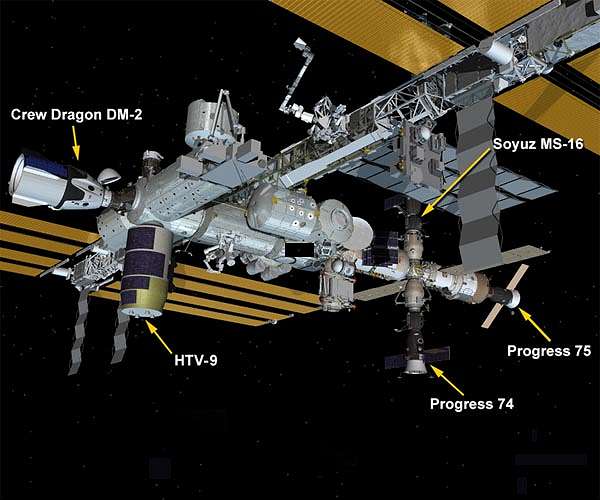
When we think of NASA missions, we usually envision intricate scientific research, brave astronauts, or heartwarming rocket launches. But few people consider how the world's most intricate distribution system actually operates. We're talking about moving supplies to the International Space Station (ISS).
The ISS travels at a speed of around 28,000 kilometers per hour. Even slight calculation errors can cost millions. That's why this process requires precision down to the second. With that in mind, how does NASA organize ultimate logistics? What technologies do they use to track every container of oxygen, water, tools, or experiments?
How NASA Tracks Every Gram
Before cargo reaches orbit, it goes through a multi-stage system:
+ Preparation,
+ Identification;
+ Monitoring.
Every detail is marked, weighed, and documented. All this is done for the purpose of complete control in conditions of maximum alert space station. After all, even a gram of weight can affect the stability of orbit or fuel consumption. NASA applies principles similar to commercial logistics systems, but in conditions of microgravity and limited space.
In a sense, NASA's cargo tracking process resembles more familiar terrestrial postal monitoring systems. In particular, the USPS service uses unique tracking numbers that allow shipments to be tracked in real time. Losing such a number makes it virtually impossible to find the package. Similarly, NASA cannot find a "lost" container without the corresponding code. The USPS system clearly shows how everyday logistics are based on the same principles of transparency, accuracy, and accountability as interplanetary transportation.
Orbital Analytics. Accuracy, Speed, and Cost of Space Delivery
NASA uses special monitoring programs. Every cargo spacecraft, whether it's SpaceX Dragon or Northrop Grumman Cygnus, is equipped with sensors that transmit telemetry in real time. Cargo is coded with RFID tags. These tags record not only the location, but also the temperature, humidity, and condition of the container. This system allows NASA to keep the maximum alert space station safe. It also allows them to:
+ Avoid overloading;
+ Optimize space inside the orbital module.
To understand the scale of the operation, it is enough to realize that the International Space Station cost exceeds $150 billion. Therefore, any delivery is a complex scientific and engineering mission. The cost of one kilogram of cargo delivered into orbit can reach tens of thousands of dollars.
That is why NASA is constantly improving its planning systems. This is done to ensure that every second of launch and every gram of payload is justified.
Precision technologies
How long does it take to get to space from Earth? It all depends on the type of mission and spacecraft. NASA's current cargo missions typically reach the ISS 6-8 hours after launch. However, ten years ago, this journey took up to two days. This speed is ensured by:
+ Precise orbital calculations;
+ Automated guidance systems that coordinate docking at speeds of over 28,000 km/h.
+ This is the ISS' speed relative to the Earth's surface.
Astronauts who receive these cargoes typically spend six months to a year in space. So, how long do astronauts stay in space? is of practical value in logistics. Food, water, and medical supplies must be distributed equitably to minimize shortages. Each delivery is scheduled as part of the crew's survival cycle.
How Was It Before? The Role of Space Shuttles
Before private companies came along, NASA relied on space shuttles. These legendary reusable spacecraft delivered crews and cargo. They demonstrated significant space shuttle advantages:
+ The ability to return equipment to Earth;
+ The ability to deliver large objects;
+ Maintaining mission flexibility.
How fast does a space shuttle travel? Approximately 28,000 km/h. Therefore, coordinating such missions required extremely precise planning.
After the flight was completed, the shuttle landing took place. The shuttle, transforming from an orbital spacecraft into a glider, entered the dense layers of the atmosphere and landed without the aid of engines. Hundreds of engineers planned these missions. They guaranteed the safety of the space shuttle crew and inspected each component of the vehicle.
Although space shuttles are no longer in operation, their legacy is preserved in modern cargo management systems. The latter combines dependability, versatility, and automation.
Visual Dimension. Accessibility of Space
Today, even an ordinary person can see the International Space Station through a telescope. Still, behind this simple sight lies a colossal infrastructure where everything has its own code, route, and delivery time. That is, from fuel valves to medical kits.
Why can't planes go to space? Airplanes are not designed to fly in a vacuum, where different fuel delivery, pressure, and thermal protection systems are required. All this makes it impossible to use traditional aviation where only carefully designed space systems work.
Conclusion
NASA has proven that even in space, it is possible to create a system similar to the best terrestrial delivery management models, but on an orbital scale. This is a true story about how humanity learned not only to send people into space, but to support them there for years. In this vast network, where speed is measured in tens of thousands of kilometers per hour and accuracy in millimeters, NASA is creating not only space missions, but also the most efficient delivery system in the known universe.
