
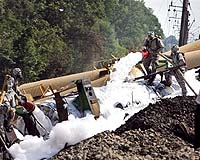
A toxic cloud of burning phosphorus gas released by a derailed train near Lviv (western Ukraine) is headed towards Belarus. Moving at a height of two or three kilometers from the ground, it does not pose any threat to aircraft traveling at much higher altitudes. In the meantime, the gas is being broken down by oxygen in the atmosphere, so hopefully we will soon be able to sigh with relief as if we have just seen a short horror movie.
In any event, this disaster deserves an entry in the Guinness Book of Records because nobody has ever seen a burning cloud of phosphorus moving in the sky.
The freight train, en route from Kazakhstan to Poland, passed through Russia without any problems. It derailed near Lviv, overturning six of its 50-ton cars loaded with phosphorus. Nobody knows for sure what caused the disaster. It could be a failure to observe safety rules or fix technical flaws in the train or the rails. Or, it might have been human error – a mistake by the engineer or traffic controller for the Lviv railway. The investigators will find out why it happened.
Luckily, the fires caused by the gas mixing with air were quickly extinguished. However, the conflagration heated the surrounding air, causing it to rise and lift some of the substance high above the ground. "This is a unique disaster. I don't remember anything like this," said Professor Lev Fyodorov, president of the Russian Union for Chemical Safety. "Usually, we deal with grams of phosphorus, and here the amount was enormous." He said there are two major dangers – we do not know the speed at which the cloud is traveling, nor how many tons have been released into the atmosphere. "We should pray that there is enough oxygen in the skies to burn it," Fyodorov said.
The drama is not yet over, and this fantastic flying fire may still land on someone's head. No doubt, Belarusians are awaiting it with memories of Chernobyl still fresh in their minds.
Professor Fyodorov thinks there are no grounds for panic. "On contact with oxygen, yellow phosphorus ignites. The blaze turns it into harmless phosphorus oxide."
earlier related report
152 hospitalised after Ukraine toxic spill
Lviv Ukraine (AFP) July 19 – A total of 152 people have been hospitalised following a spill of highly toxic phosphorus in western Ukraine, officials said Thursday.
The number admitted to hospital after a train carrying the toxic cargo derailed Monday afternoon, spewing toxic clouds into the air, nearly doubled overnight Wednesday.
But officials repeated assurances that there was no widespread danger to surrounding villages.
"The situation is stable and under control. No one is panicking," emergency situations ministry spokesman Pavlo Vasylenko told AFP.
Emergency workers on the site Thursday removed wreckage and covered the ground with flame retardant to avoid another flare-up, which could happen if the temperature goes above 30 degrees Celsius (86 degrees Fahrenheit), he said.
The accident took place when a train with 15 wagons of highly flammable yellow phosphorus derailed en route from Kazakhstan to Poland, where it was to be used to make fertiliser.
Deputy Prime Minister Olexander Kuzmuk, who on Tuesday compared the spill to the 1986 Chernobyl nuclear disaster, has since insisted there is no health risk to surrounding villages.
However several people in the zone — home to some 11,000 people — have removed their children from the area. A Russian circus troupe has meanwhile deferred plans to perform at Lviv.
Kuzmuk appeared on local television in Lviv on Wednesday drinking local well water and eating a cucumber grown near the accident site.
Regional prosecutors are investigating whether the accident was caused by the violation of security regulations on phosphorus transport.
The accident has fuelled political tensions with pro-Western President Viktor Yushchenko accusing the government of his foe, Kremlin-backed Prime Minister Viktor Yanukovych, of trying to "hide" the gravity of the accident.
He said some government officials were "trying to replace action with words about wells which had not been contaminated by phosphorus."
Source: Agence France-Presse
Source: RIA Novosti
