
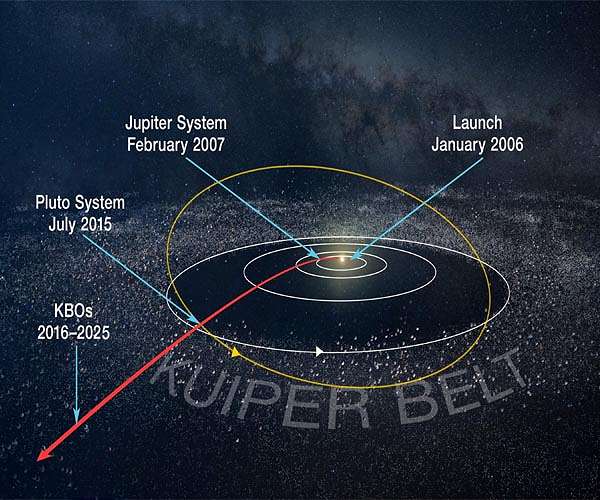
New Horizons remains healthy from its position deep in the Kuiper Belt, even as it speeds farther from the Earth and Sun by about 300 million miles per year! The spacecraft, which began its second extended mission on Oct. 1, also continues its record-length hibernation that began June 1 and ends March 1.
Hibernation, which takes place in spacecraft "spin mode," saves fuel and wear and tear on the vehicle, as well as mission budget. But even in hibernation, New Horizons collects dust impact and plasma and charged particle measurements around the clock to better understand the environment of the Kuiper Belt and the Sun's outer heliosphere.
Once New Horizons exits hibernation, our pace of activity will pick up dramatically. We'll begin by downlinking the science data from hibernation and the final few gigabits of data from our encounter with the Kuiper Belt object Arrokoth.
Then, in the third week of April, the spacecraft will de-spin and begin 5 to 6 weeks of intensive planetary science, astrophysics and heliophysics observations using its onboard cameras. Among the investigations: studies of Uranus' and Neptune's energy balances; distant KBO observations; studies of both visible and ultraviolet cosmic background light; and mapping the "local" interstellar hydrogen gas. In addition, New Horizons will continue to make round-the-clock dust impact, plasma and charged particle spectrometer measurements, just as it did in hibernation.
Once we complete this intensive science period in May, New Horizons will resume its spin mode and begin a multi-month downlink of these new data, along with still more final Arrokoth science data. Then, in September, the spacecraft will again de-spin to collect more remote sensing observations for planetary science, astrophysics and heliophysics.
But there's more news on the New Horizons project than science data collection and downlink plans! For one, our team of project scientists, which leads the mission's science planning, has changed.
Former long-time Project Scientist Hal Weaver, of the Johns Hopkins Applied Physics Laboratory (APL), has stepped down as he begins to ease into retirement; replacing Hal is Kelsi Singer, of the Southwest Research Institute (SwRI). Stepping in to Kelsi's former role are Pontus Brandt, of APL, and Anne Verbiscer, of SwRI and the University of Virginia. John Spencer, of SwRI, will continue as deputy project scientist as well.
Our Ralph and Long Range Reconnaissance Imager (LORRI) camera teams have new leadership too. Carly Howett, of the Planetary Science Institute, and Silvia Protopapa, of SwRI, have taken on the Ralph instrument principal investigator (PI) and deputy PI roles, and Olivier Barnouin and Terik Daly, both of APL, are the new LORRI PI and deputy PI. I want to congratulate and thank all of these hard-working team members on their leadership roles in our second extended mission!
