
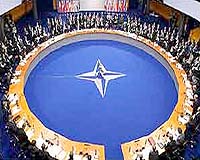
There is a basic equivocation about the foundations of the North Atlantic Treaty Organization that goes back to the very beginning of the alliance in the early days of the Cold War.
Reading the preamble to what was known at the time as the Treaty of Washington, the treaty that established NATO on April 4, 1949, one gets the idea that the Atlantic alliance was all about getting together to preserve shared values:
"The parties to this treaty … are determined to safeguard the freedom, common heritage and civilization of their peoples, founded on the principles of democracy, individual liberty and the rule of law. They seek to promote stability and well-being in the North Atlantic area.
"They are resolved to unite their efforts for collective defense and for the preservation of peace and security. They therefore agree to this North Atlantic Treaty."
But while the values referred to in the preamble were in some measure truly shared, the real reason justifying the birth of this unprecedented alliance was to create a deterrent against Soviet ambitions in Europe. And NATO, with all its flaws, by creating some kind of a united Western Front, did its job. So, while values were important, the real deal was fear of the Red Army and the military power of the Soviet Union.
We know what happened regarding the Soviets. The Soviet Union disintegrated at the end of 1991, and the Soviet-led Warsaw Pact military alliance, which was formalized in 1955, vanished. So, as of the 1990s, the geopolitical reality in Europe having been dramatically altered and entirely in our favor, was there a residual mission for NATO? And, if so, what would it be?
Any serious discussion about any relevant new mission should have been premised by a check on the validity of the preamble quoted above. But, while useful in the abstract, this exercise was avoided. No one intended to seriously verify to what extent there really was any spiritual glue holding together Europe and North America and whether this assumed kinship would make both sides work together to preserve peace and stability in a future post-Cold War environment.
So, the "stress test" — to borrow an appropriate expression in use by the Obama administration for a needed check on the health of financial institutions — was not applied to NATO. It was assumed that all was well and that all the member states of the alliance continued to agree on the fundamentals even though the Soviet Union, which was the threat that had kept the NATO members together for so long, had now vanished from the scene.
Part 3: The bureaucratic inertia that kept NATO rolling in the 1990s.
(Paolo Liebl von Schirach is the editor of SchirachReport.com, a regular contributor to Swiss radio and an international economic-development expert.)
(United Press International's "Outside View" commentaries are written by outside contributors who specialize in a variety of important issues. The views expressed do not necessarily reflect those of United Press International. In the interests of creating an open forum, original submissions are invited.)
Share This Article With Planet Earth
