
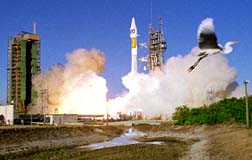
An Atlas-Centaur rocket on Saturday launched the Terra satellite, a joint US, Canadian and Japanese earth observation mission, from Vandenberg Air Force base in California, NASA announced.
Terra, formerly known as EOS AM-1, will be the first satellite capable of studying the interaction of land, sea, air, ice and vegetation as part of a global system as well as their impact on the atmosphere and climate.
The separation of rocket and satellite occurred 14 minutes after the launch, said Julie Andrews, a spokeswoman for International Launch Services (ILS), the company which handles the launcher.
"The Terra mission has nearly unlimited potential to improve scientific understanding of global climate change," Ghassem Asrar, associate administrator for the Office of Earth Science at the National Aeronautics and Space Administration, earlier explained.
"Terra will simultaneously study clouds, water vapor, aerosol particles, trace gases, terrestrial and oceanic properties, the interaction between them and their effect on atmospheric radiation and climate," added Asrar.
Terra will orbit at an altitude of 705 kilometers (438 miles) and will cover the earth's entire surface in 16 days.
The mission is scheduled to last six years but could continue for 15 years, according to NASA.
Canada has also provided its Measurements Of Pollution In The Troposphere (MOPITT) instrument, which is tasked with studying concentration of carbon monoxide and methane in the troposphere.
Japan's Ministry of International Trade and Industry is contributing ASTER, an device which examine cloud, vegetation and minerals and ground temperature in different world regions.
