
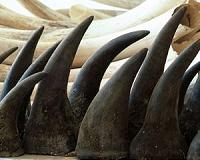
A Tanzanian court jailed four Chinese men for 20 years after they were caught smuggling 11 rhino horns, one of the largest seizures ever made in the east African nation, a lawyer said Friday.
"The convicts are also required to pay a fine of $800 each, apart from the jail sentence," state attorney Wankyo Simon told AFP by telephone, from Tanzania's south-western Mbeya region.
The four men, identified as Song Lei, Xiao Shaodan, Chen Jianlian and Hu Liang, were arrested in the Mbeya region last month as they crossed into Tanzania from Malawi. They were sentenced on Wednesday.
Hundreds of rhinos are massacred every year for their horn, which is used in East Asia for its supposed medicinal qualities.
Demand for rhinoceros horn — made of keratin, which is also found in hair and nails — has boomed in Vietnam and China, where it is valued for its supposed medicinal properties.
The highest levels of rhino poaching takes place in South Africa, which is home to around 20,000 rhino, or 80 percent of the world population.
Poaching is rampant in east African nations including Tanzania and Kenya, but poachers there focus more on elephant killing.
Large ivory hauls seized in Vietnam and Thailand
Hanoi (AFP) Dec 18, 2015 –
Nearly three tonnes of ivory have been seized in Vietnam and Thailand, officials said Friday, highlighting the still thriving black market trade for illegal animal parts in southeast Asia.
Vietnamese officials said 2.2 tonnes of tusks, originating from Mozambique, had been discovered on Thursday buried among sacks of beans, a customs official from northern Hai Phong port told AFP, asking not to be named.
In Thailand, wildlife officials displayed more than 700 kilogrammes of ivory items that were seized last week on the island of Koh Samui.
A customs official told AFP the tusks were found in a cargo container that was marked as carrying hair wigs, adding the shipment had been sent from Singapore and was on its way to Laos.
Tusks and other body parts of elephants are prized for decoration as talismans and for use in traditional medicine across parts of Asia, with China being a major market for such products.
The international trade in ivory, with rare exceptions, has been outlawed since 1989 following the drop in the population of African elephants from millions in the mid-20th century to just 600,000 by the end of the 1980s.
But that has not stopped criminal gangs seeking to exploit the continued demand for the material in Asia.
Vietnam outlawed the ivory trade in 1992, but shops can still sell ivory dating from before the ban.
Police have made frequent, hefty seizures of dozens of tonnes of tusks, rhino horns and pangolin scales this year.
In Thailand, the country's junta is cracking down on the lucrative trade.
In August it incinerated more than two tonnes of confiscated ivory, the first time the kingdom has taken steps to destroy part of its stockpile.
It has also ordered all Thais to register any ivory they own, warning that those who fail to do so will have their items confiscated.
They have also made a series of high profile hauls, including four tonnes of ivory found hidden in containers in April that originated in the Democratic Republic of Congo and were destined for Laos.
