
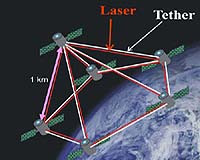
A California researcher has developed a new concept that could enable fleets of small spacecraft to fly in ultra-precise formations using a combination of laser-guided positioning and physical tethers.
The idea could significantly lower launch weights and station-keeping costs while dramatically improving observation resolutions from space. NASA is interested enough that its Institute for Advanced Concepts has awarded Young Bae, of the Bae Institute, a $75,000 grant to develop his Photon Tether Formation Flight system.
Bae, who unveiled the PTFF concept last March at a NIAC fellows meeting, said his patent-pending system can achieve positioning accuracies of less than a nanometer – or billionth of a meter. It also would reduce the power requirement for formations of 100 kilogram (200 pound) spacecraft configurations to several watts per pair of satellites – well within today's spacecraft power budgets.
No other propellant is needed, Bae added, thereby saving mass, energy and the need for contaminant-free operations for space missions equipped with highly sensitive instruments.
The core technology is a combination of push-force laser thrusters and pull-force Kevlar tethers. The lasers amplify thrust tens of thousands of times through a proprietary intracavity system that bounces photons off of mirrors between satellites.
Bae said the PTFF system could improve the effectiveness of missions involving geophysical and environmental monitoring, mapping and imaging, as well as surveillance, astronomical and GPS applications.
