
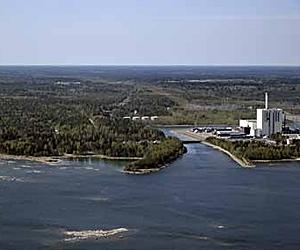
A Swedish nuclear industry group applied to authorities Wednesday for permission to bury nuclear waste for the period it is unsafe, but Greenpeace protesters warned of the risks of leakage.
If the plan is approved, Sweden could become the first country in the world to bury spent nuclear for the whole time it is considered dangerous, which is around 100,000 years.
The Swedish Nuclear Fuel and Waste Management (SKB) applied to build an end-repository in Forsmark, in the centre of the country, and a mid-term storage capsule in Oskarshamn in the south, company spokesman Carl Sommerholt said.
The application handed to the Swedish Radiation Safety Authority would see the waste from the country's 10 nuclear reactors buried 500 metres (1,640 feet) underground.
"After 30 years of research, we feel we have a solution that, if built the way we suggest, will provide a secure end-storage system," Sommerholt told AFP.
Sommerholt said the proposal would be assessed and it would likely take a few years at least before SKB could receive the green light to begin building.
"We hope we will be able to start construction around 2015," he said.
SKB is owned by Sweden's nuclear power plant owners.
Around 25 Greenpeace protestors gathered outside the company's offices in downtown Stockholm Wednesday before it handed in its application, saying there was no guarantee against leakage and asking SKB to reconsider lodging the bid.
"There is still a lot of criticism from many scientists saying the methods they are using cannot guarantee that no radioactivity will leak out during the 100,000 years that this is dangerous waste," Martina Krueger, who is in charge of energy matters at Greenpeace, told AFP.
The protesters were dressed in white nuclear protection jumpsuits and masks resembling a mix of yellow radiation warning signs and Norwegian master Edvard Munch's Scream.
The message the protesters wanted to convey to SKB, Krueger said, was: "Do further investigations to find a way to do this where you can really guarantee that no radioactivity will leak out, and don't pretend that you have the answer."
"The dangers of radioactivity are quite obvious today," she said, referring to the nuclear catastrophe in Japan but adding the protest was not linked to fears over the quake-hit plants there.
earlier related report
EU wants stress tests for its reactors
Brussels (UPI) Mar 16, 2011 –
The European Union plans to carry out stress tests at the continent's nuclear reactors, amid concerns that some of them aren't protected from natural disasters such as the earthquake and tsunami that hit Japan.
After a hastily convened meeting of nuclear safety experts, energy industry officials and EU environment ministers on Tuesday in Brussels, European Energy Commissioner Guenther Oettinger announced that nuclear reactors in the EU would have to undergo stress tests.
Non-EU members in Europe, for example Switzerland and Russia, which are home to five and 32 reactors, respectively, should also test their facilities, Oettinger said.
The decision comes amid an escalating nuclear crisis in Japan, where a double blow of an earthquake and a tsunami severely damaged three reactors in the country's northeast.
Authorities have been frantically trying to get the situation under control but a series of explosions at the nuclear power plant of Fukushima, around 150 miles north of Tokyo, have increased fears of a core meltdown and a large discharge of radiation. Around 200,000 people have been evacuated from the area.
In Europe, the disaster has led to hastily taken policy decisions.
The Swiss government Monday suspended the approvals process for three new nuclear power stations amid the Japanese crisis and said it was checking its existing plants for safety.
Germany decided to shut down for at least three months seven of its oldest reactors and will check up on all 17 if they're safe enough to continue producing electricity.
The move came as a surprise as it did away with an unpopular decision taken last fall to extend the lifetime of Germany's 17 reactors by an average of 12 years.
It's unclear what the stress tests planned by the European Union will actually look like; this would be decided at meetings next month, the Commission said.
The German safety tests, which could serve as a blueprint, are to cover earthquakes, tsunamis and terrorist attacks, German Chancellor Angela Merkel indicated Monday.
While Berlin said it has the power to enforce these security checkups, Brussels can't make them binding, Oettinger said, meaning that nuclear power operating firms will have to voluntarily agree to them. At least one company, German utility RWE, has vowed to cooperate with Berlin on the safety checks and it isn't expected that companies or member states in Europe block the EU-wide tests.
According to the European Nuclear Society, Europe is home to a total of 163 nuclear reactors, with the largest share in France (58), Britain (19) and Germany (17). Another 32 reactors are in Russia, with five of them on the country's Asian continental shelf.
Share This Article With Planet Earth
