
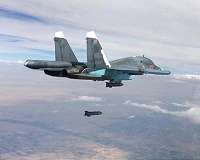
Air strikes thought to have been carried out by Russian jets on a rebel-held residential area in northwestern Syria have killed 51 civilians, a Britain-based monitor said on Friday.
Nine children were among those killed when the strikes hit the Zardana area of Idlib province late Thursday, the Syrian Observatory for Human Rights said.
Observatory head Rami Abdel Rahman said the toll was rising because more bodies had been found under the rubble of houses destroyed in the air strikes. Dozens were wounded, he said.
The Russian defence ministry dismissed the Observatory's reports of strikes on Zardana as having "nothing to do with reality", in a statement carried by Russia's TASS news agency.
Zardana is largely controlled by Islamist rebels, with a small presence of the Hayat Tahrir al-Sham alliance led by Syria's former Al-Qaeda affiliate.
An AFP correspondent at the scene saw volunteers with a crane still searching the rubble.
Half a dozen men in civilian clothes helped carry a person in a black body bag away from the site of the strikes, which pulverised several buildings.
Most of Idlib province is held by an array of Islamist and jihadist groups with only parts controlled by the Russian-backed government.
Since Russia intervened in its support in 2015, the government has regained control of around half of the country, driving back rebels.
More than 350,000 people have been killed in the Syrian war since it started in 2011 with the brutal repression of anti-government protests.
The Observatory says it relies on sources inside Syria for its information, and determines who carried out strikes on the basis of flight patterns, and the type of aircraft and ammunition used.
Judge questions plan to release US detainee into Syrian war zone
Washington (AFP) June 8, 2018 –
A federal judge questioned on Friday the US military's plan to dump a US citizen alleged to have joined the Islamic State group back into the Syrian war zone, a plan his lawyers said equalled a death sentence.
The Justice Department announced late Wednesday that US forces were preparing to release the man, a dual US-Saudi citizen identified only as "John Doe," into territory controlled by allied Syrian Democratic Forces as early as Saturday, after having held him as an alleged "enemy combatant" for nine months.
The plan is to give him food and water "for several days", a new cellphone, and the $4,210 he was originally captured with, but no identification, and leave him on his own in northeastern Syria where the SDF dominate.
In a hearing in the Washington federal court, Judge Tanya Chutkan asked Justice Department lawyers why there was a "rush" to release the man into a country so dangerous that the US State Department has warned against any travel and even advised potential visitors to "draft a will" first.
"We are in uncharted territory," she said. After months of battling over the man's rights as an uncharged battlefield detainee with US citizenship, "what is the urgency in this case?" she asked.
Government lawyer James Burnham defended the plan, saying the SDF is "a trusted local partner" of the US forces and the area is "much better, much safer" than where he was taken prisoner by the SDF last September.
The American Civil Liberties Union lawyer for "John Doe," Jonathan Hafetz, disputed this, saying the US still contends the man was a fighter for Islamic State before he was detained, and so the SDF would consider him an enemy.
According to the laws of war, Hafetz argued, "you can't release an alleged enemy prisoner into a place that is unsafe."
"It's like they are releasing him into a burning building," he said, calling it a "death warrant."
The case has become a test of the Trump administration's plan for handling Americans captured abroad fighting for jihadist groups.
The government spent months fighting in court against giving him legal representation, and has never charged him or offered evidence that he was a fighter for IS.
The man was born in the United States to Saudi parents. He denies having joined Islamic State and claimed he was in the area to do reporting, according to the ACLU.
The government first moved to transfer him to Saudi Arabia.
But his lawyers persuaded the court to block that, arguing that the US government has no right to summarily hand a US citizen over to another government with no charges or extradition proceedings.
Hafetz said the government could release the man in Iraq, where he has been held, giving him a chance to request a new passport at the US consulate there.
"He doesn't want to stay in prison but he doesn't want to go out where he is in grave danger," Hafetz said.
In the end, Chutkan, stressing the untested legal questions involved, persuaded the government lawyers to agree to hold off on the release until another hearing on June 20.
