
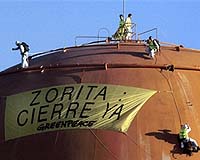
Spanish Prime Minister Jose Luis Rodriguez Zapatero vowed Wednesday to reduce the country's dependence on nuclear power in favour of renewable sources of energy if reelected in March.
"My position is not to increase nuclear energy in our country but rather to progressively reduce it and to make a collective effort in favour of renewable energy," Zapatero told an economic forum in Madrid.
"It would be easier to say that we are going to increase nuclear energy but it is better for us, as a country, to accept the difficult and ambitious challenge that our alternative energy is renewable and not nuclear," he said.
His statement comes as soaring oil prices and international pressure to reduce greenhouse gas emissions have revived interest in nuclear energy in many countries, such as the United States, Britain and China.
A progressive downsizing of Spain's nuclear energy programme was part of the platform of Zapatero's Socialist Party in elections four years ago. Zapatero is now seeking a second mandate in elections on March 9.
Spain has eight functioning nuclear reactors which generate 22.88 percent of the country's electricity needs. It has also developed renewable energy sources, particularly wind power.
Zapatero said in November that Spain, which has one of the worst records in the EU on greenhouse-gas emissions, now wants to take a leading role in the fight against global warming.
Greenhouse gas emissions in Spain rose 3.6 percent in 2005. Spain's annual pollution is now 53.5 percent more than in 1990 — the year of reference for pledges under the Kyoto Protocol.
Under Kyoto, 15 EU nations that made a collective commitment under the UN pact promised a reduction of eight percent by the end of 2012, when the treaty runs out.
