
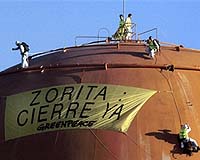
Spain's oldest nuclear power plant was due to close for good on Sunday night after 38 years, becoming the first station in Spain to shut down as a result of political activity.
Environmentalists welcomed the closure as a victory, though the country's ruling Socialist Party has recently adopted a more favourable stance towards nuclear power in the context of soaring oil prices.
The Jose Cabrera nuclear power station at Almocinad de Zorita, near Guadalajara in central Spain, was due to cease production at 11:30 pm local time (2130 GMT).
The government decided to close the plant after campaigns by environmental groups, who said it was unsafe.
Union Fenosa, the plant's owner, insists that it could have completed its cycle of 40 years' production without any problems and closed down in 2008, as originally planned.
Greenpeace used the occasion to remind Prime Minister Jose Luis Rodriguez Zapatero of his campaign promise progressively to close the whole of Spain's nuclear power sector.
"There is currently far too much ambiguity in the government over this issue," the organisation's campaign director in Spain, Mario Rodriguez, told the Europa Press agency.
The Spanish left was vehemently opposed both to nuclear power and to NATO in the early 1980s, but gradually rallied to the pragmatic attitude adopted by Felipe Gonzalez's socialist government as the decade went on.
Before Sunday night, Spain had seven nuclear power stations totalling nine reactors and generating just under a quarter of the country's electricity.
The country's industry ministry has been promoting debate between the state, ecological campaigners and businesses by organising monthly working groups to discuss the future of Spain's nuclear sector.
Union Fenosa plans to replace the Jose Cabrera plant with a gas-fired, combined-cycle power station at the same site, equipped with two 400-megawatt generators — making it five times more powerful than its predecessor.
Source: Agence France-Presse
