
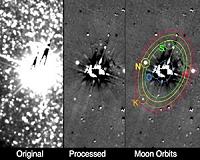
NASA's New Horizons team has analyzed the first set of hazard-search images of the Pluto system taken by the approaching spacecraft itself – and so far, all looks clear for the spacecraft's safe passage. The observations were made May 11-12 from a range of 47 million miles (76 million kilometers) using the telescopic Long Range Reconnaissance Imager (LORRI) on New Horizons.
For these observations, LORRI was instructed to take 144 10-second exposures, designed to allow a highly sensitive search for faint satellites, rings or dust sheets in the system.
The mission team is looking carefully for any indications of dust or debris that might threaten New Horizons before the spacecraft's flight through the Pluto system on July 14; a particle as small as a grain of rice could be fatal.
The observations, downlinked to Earth May 12-15 and processed and analyzed May 12-18, detected Pluto and all five of its known moons, but no rings, new moons, or hazards of any kind.
The New Horizons hazard detection team, led by John Spencer of the Southwest Research Institute in Boulder, Colorado, determined that small satellites with about half the brightness of Pluto's faintest known moon, Styx, could have been detected at this range.
Any undiscovered moons outside the orbit of Pluto's largest and closest moon, Charon, are thus likely smaller than 3-10 miles (5-15 kilometers) in diameter.
If any undiscovered rings are present around Pluto outside Charon's orbit, they must be very faint or narrow – less than 1,000 miles wide or reflecting less than one 5-millionth of the incoming sunlight.
The next hazard-search images will be taken May 29-30, and should have about twice the sensitivity of the first batch. The team expects to complete a thorough analysis of the data and report on its results by June 12. The New Horizons team has until July 4 to divert the spacecraft to one of three alternate routes if any dangers are found.
New Horizons is nearly 2.95 billion miles from home, speeding toward Pluto and its moons at just under 750,000 miles per day. The spacecraft is healthy and all systems are operating normally.
