
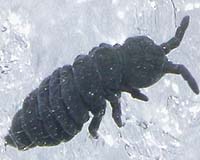
A new antifreeze protein discovered in tiny snow fleas by Canadian researchers may allow organs to be stored longer before being transplanted.
Drs. Laurie Graham and Peter Davies – at Queen's University, in Kingston, Ontario – found that the potent protein produced by the fleas to protect themselves against freezing is capable of inhibiting ice growth by about 6 degrees Celsius.
This would allow organs to be stored at lower temperatures, expanding the time allowed between removal and transplant, the researchers say in the journal Science.
"Transplant organs must now be kept at the freezing point or slightly warmer," says Graham. "If we can drop the temperature at which the organ is safely stored, there will be a longer preservation period."
