
Observations of the Coma cluster carried out by Swiss astronomer Fritz Zwicky in 1933 implied that the system's total gravitating mass was far larger than that which could be detected from starlight or emission from intra-cluster gas. He proposed "dunkle Materie," or dark matter, as a binding agent for the cluster.
As years passed, new and more refined observations of clusters and of individual galaxies all hinted at the existence of some unseen force holding galaxies together. Although the dark matter hypothesis originated from observations of galaxy and cluster dynamics, it has since been vindicated in a far wider variety of observations, including the topology of the large-scale structure of the universe and the cosmic microwave background.
In spite of its success, the dark matter particle has not yet been directly detected. Alternatives to the hypothesis have therefore been proposed, and continue to receive much attention. In particular, Modified Newtonian Dynamics, or MOND, posits an alternative relationship between mass and gravity and is remarkably successful at describing the observed rotation velocities of stars in galaxies without invoking unseen dark matter.
One particular observational relationship that has been troubling astronomers over the past decade or so is the "Mass Discrepancy-Acceleration Relation," or MDAR. The MDAR highlights a close coupling between the luminous mass of galaxies (i.e., their starlight) and their total gravitating mass.
It implies that all galaxies follow a single relation for the radial dependence of their enclosed baryonic-to-dynamical mass ratio and the gravitational acceleration due to baryons. The relation is consistent with even the simplest forms of MOND, and is one of the main supporting arguments of the theory.
The fact that this relation holds independently of galaxy mass, luminosity, gas content or size has troubled pundits of the dark matter model. If dark matter were real, why would a population of galaxies so diverse as those we observe obey such a simple relation between dynamics and starlight?
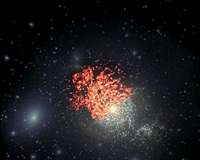
Using large-scale computer simulations we have shown that the MDAR is a natural outcome of galaxy formation in the dark matter model. Our simulations form realistic galaxies when judged according to variety of diagnostics but, most importantly, reproduce the observed MDAR remarkably well.
This solves a long-standing problem that has troubled the dark matter model for over a decade. The dark matter hypothesis remains the main explanation for the source of the gravity that binds galaxies. Although the particles are difficult to detect, physicists must persevere.
Penn researchers provide new insight into dark matter halos
Research from the University of Pennsylvania could shed light on the distribution of one of the most mysterious substances in the universe. In the 1970s, scientists noticed something strange about the motion of galaxies. All the matter at the edge of spiral galaxies was rotating just as fast as material in the inner part of the galaxy. But according to the laws of gravity, objects on the outskir … read more
