
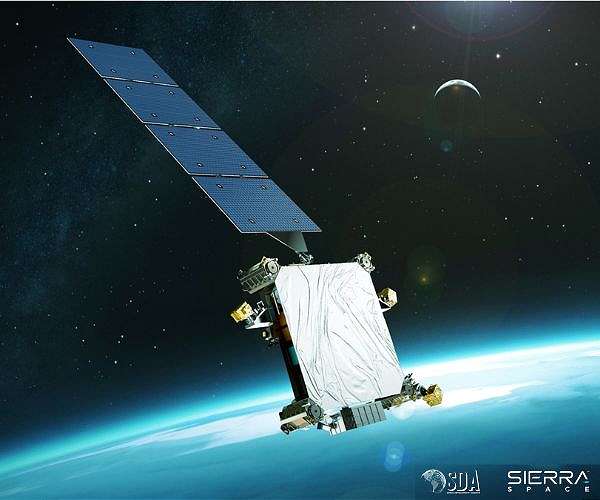
Sierra Space has won a major contract with the Space Development Agency (SDA). Valued at $740 million, the contract tasks Sierra Space with designing, producing, delivering, operating, and sustaining 16 missile warning and tracking satellites, alongside two additional satellites for missile defense and fire control. This deal also encompasses two operational ground segments, consolidating Sierra Space's role in national security space programs.
This contract is awarded through an Other Transaction Authority (OTA), a streamlined procurement method favored by the U.S. Department of Defense for its flexibility and efficiency. The satellites in question form part of the SDA's Tranche 2 Tracking Layer, a segment of the Defense Department's Low Earth Orbit constellation. This constellation aims to enhance global, persistent monitoring for conventional and advanced missile threats, including the increasingly prominent hypersonic missile systems.
Sierra Space CEO Tom Vice commented on the award: "Under the $740 million SDA contract, Sierra Space will deliver an 18-satellite constellation for missile detection and warning with fire control quality tracks." He highlighted the company's strengths, including its experienced team, innovative technologies, commercial practices, and reliable performance, which have cumulatively led to Sierra Space securing approximately $1.3 billion in space-based national security programs.
Rusty Thomas, Chief Technology Officer and SVP/GM Space Applications at Sierra Space, emphasized the critical nature of missile warning and defense. "Missile warning and missile defense is critical to the safety and security of our nation and its people," he stated, noting the significance of Sierra Space being chosen over traditional big primes for this mission-critical contract.
The tracking layer satellites will be equipped with optical sensor payloads developed by Sierra Space's mission payload partner, GEOST, a LightRidge Solutions company. GEOST specializes in creating high-performance, multi-orbit optical payloads that are affordable, low-weight, and low-power. These payloads come with integrated on-orbit processing and ground-based infrastructure, key features for space warfighting architectures.
This latest contract propels Sierra Space into a pivotal role as a supplier of satellites for the SDA. Included in the agreement is a $20 million incentive for on-time delivery, underscoring the importance of adherence to the project timeline. Sierra Space will develop, integrate, and test its space vehicles at its satellite production facilities in Colorado, leveraging its existing infrastructure and expertise.
