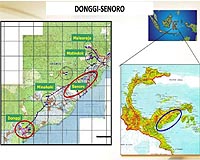
Two Japanese power companies cannot take the Indonesian government to international arbitration for breach of contract regarding the massive Donggi-Senoro liquefied natural gas project in Sulawesi, an Energy Ministry official said.
Japan's Kansai Electric and Chubu Electric Power agreed in February to purchase 1 million tons each of LNG from the Donggi-Senoro consortium. In March the Energy and Mineral Resources Ministry rejected the contract with Kansai and Chubu, claiming their prices were too low.
Then on June 18 Jakarta announced that all gas from the Donggi-Senoro field should be sold domestically, putting the future of the $1.4 billion plant in jeopardy.
"We cannot export gas overseas, while at the same time our industry faces gas shortages. Independence in energy is critical," Indonesian Vice President Jusuf Kalla said June 18, the Jakarta Post reported.
On Tuesday Evita Legowo, the Energy Ministry's director general of oil and gas, said the Japanese companies could not involve the government in international arbitration, as had been rumored to occur. She said the initial supply agreements were temporary and the ministry had the right to approve the sales price, the Jakarta Globe reported.
"The government has not signed anything related to the project. The initial agreement was between the companies concerned," she said.
The Donggi-Senoro consortium consists of state-owned oil and gas producer PT Pertamina, PT Medco Energy International and Japan's Mitsubishi, which holds a 51 percent stake.
Consortium partners have said that exporting the output of the Donggi-Senoro field is essential to the economic viability of the project and an export-oriented approach would also benefit Indonesia.
Following Jakarta's decision last month, a spokesman from Pertamina, which holds a 20 percent stake in the Donggi-Senoro project, said the consortium was planning to stick to its Japanese contracts.
"We honor the government's decision. But the next step for the project remains undecided. That's why we'll continue to talk to the government," the spokesman told the Globe, adding, "The government stands to benefit from the project if the LNG is also exported."
The Pertamina spokesman noted that Mitsubishi's involvement in Donggi-Senoro was largely because the intention had always been to sell the majority of the plant's gas to Japanese buyers. Mitsubishi's role in the project is considered crucial to its success.
Indonesia is the world's third-largest LNG exporter after Qatar and Malaysia.
The Donggi-Senoro plant, due to become operational in 2012 or 2013, would provide a much-needed boost to Indonesia's LNG production as it struggles to juggle exports amid declining worldwide demand as well as meet domestic energy needs.
Share This Article With Planet Earth