
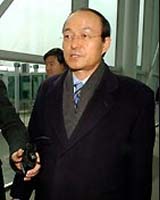
South Korea's new foreign minister on Wednesday urged North Korea to take "tangible" steps towards nuclear disarmament when six-party talks resume next week after a 13-month break. Song Min-Soon said South Korea and its allies were ready to show flexibility in offering diplomatic and economic incentives if the North is committed to scrapping its nuclear weapons programme.
"South Korea and other countries will show flexibility if North Korea takes tangible steps to dismantle its nuclear programme," he said.
Song urged the communist state to be sincere in discussing ways to implement a joint agreement reached at the forum on September 19 last year.
"It is important to reach an agreement on steps to be taken by North Korea at an early stage in implementing the September 19 joint statement. It is surely in the interests of North Korea," he said.
Under that deal, Pyongyang agreed in principle to scrap its nuclear programme in return for security guarantees, energy benefits and other aid.
But it pulled out of the forum in November 2005 in protest at the US decision to blacklist Macau's Banco Delta Asia over its North Korean accounts. Washington said it suspected they were the proceeds of counterfeiting and other crimes.
The North conducted its first nuclear weapons test on October 9, triggering global condemnation and United Nations sanctions.
Song was formerly Seoul's chief envoy to the talks which began in 2003 and also group the United States, Japan, Russia and host China. The next round is scheduled to start on Monday.
He said it was hard to set a benchmark to determine the success or failure of the upcoming talks. "It requires a long process, and it is difficult to say how much should be achieved during a few days of negotiations."
US Secretary of State Condoleezza Rice told AFP Monday she wanted quick results in the talks, and set a two-year timeframe for the North to take irreversible steps towards dismantling its nuclear weapons programme.
US-based experts say Washington wants it to halt the operations of its nuclear reactor at Yongbyon and accept inspections by the International Atomic Energy Agency.
The North agreed to return to the six-nation talks on condition the issue of the US financial restrictions is "discussed and settled" within the framework of the forum.
earlier related report
NKorea talks can open discussion on rights: UN rapporteur
Tokyo (AFP) Dec 13 – Next week's six-way talks on North Korea's nuclear program can serve as an entry point to discuss human rights, the UN special rapporteur on rights in the communist state said Wednesday.
Vitit Muntarbhorn told journalists that North Korea's kidnappings of Japanese nationals will be a major part of his report to be presented next year to the United Nations.
"We know very well that primarily the six-party talks is about the nuclear issues. But it does not have to neglect totally human rights concerns," said Muntarbhorn, who is a law professor of Chulalongkorn University in Bangkok.
"There may be space for incorporating elements of human rights in the discourse. You can have parallel tracks, different speeds," he said.
"There are various options available," he said when asked if the kidnappings should be discussed.
Muntarbhorn was visiting Japan this week to hear from political leaders and families of people kidnapped by North Korean agents in the 1970s and 1980s to train the regime's spies.
His trip came ahead of Monday's resumption of six-nation disarmament talks after a 13-month hiatus, during which North Korea tested an atom bomb.
"A positive development on that front will contribute to the space for humanitarian action," Muntarbhorn said of the talks.
Japan has said it plans to use next week's negotiations to press North Korea again over its kidnappings of at least 17 Japanese civilians.
North Korea has repeatedly demanded that Japan be excluded from the talks.
"The abductions of Japanese nationals by the DPRK (North Korea) is a major concern to the mandate of the special rapporteur," Muntarbhorn said.
He said, however, his official capacity does not include six-party talks. He has yet to be allowed to visit North Korea since his appointment in July 2004.
Source: Agence France-Presse
