
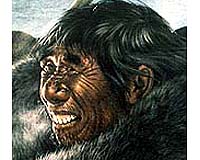
Collaboration between anthropologists in Germany and a U.S. company may reveal why Neanderthals were displaced by modern humans 30,000 years ago.
The effort led by the Max Planck Institute in Leipzig involves reconstructing the genome of Neanderthals using 45,000-year-old bones found in Croatia, the New York Times reports Friday.
The decoding is possible because of a new method of DNA sequencing developed by a Connecticut company, 454 Life Sciences, which can do the work with a small amount of material.
Recovery of the Neanderthal genome would be invaluable for answering the many questions about human prehistory and evolution.
There has been a longstanding dispute among scientists concerning whether modern humans, who migrated to Europe from Africa, interbred with Neanderthals or forced them into extinction.
University of Chicago geneticist Bruce Lahn says interbreeding would have been beneficial to humans because the Neanderthals were adapted to the cold European climate as well as local diseases.
Another important question that researchers are hoping to answer is which genes make humans human. That will be done by comparing the DNA of humans, chimps and Neanderthals.
Source: United Press International
