
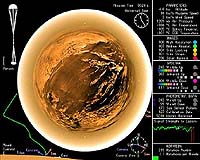
University of Arizona scientists have built two movies from data collected during the Huygens probe's descent to Titan's surface on Jan. 14, 2005. The movies show the operation of the NASA-funded Descent Imager/Spectral Radiometer camera during its descent and after touchdown.
The movies compress the almost four-hour-long operation of the camera to less than five minutes, or 40 times faster than the actual descent and 100 times actual speed thereafter.
Erich Karkoschka of UA's Lunar and Planetary Laboratory and the DISR team created the both movies. He said mission scientists were extremely busy analyzing data for months after the landing, so they did not have a chance to give the public a good overview of the mission until now. "I hope the new movies help to put the different results into context," he said.
Karkoschka said he wanted the movies "to show what the Huygens probe 'saw' within a few hours. At first, the Huygens camera just saw fog over the distant surface, but after landing, the probe's camera could resolve little grains of sand millions and millions times smaller than Titan. A movie is a perfect medium to show such a huge change of scale."
DISR team member Chuck See scripted the movies, called "The View from Huygens on January 14, 2005." They run four minutes 40 seconds. KUAT radio broadcaster David Harrington narrated, and Debbie Hu, of Yelm, Wash., accompanied another version with a performance of Beethoven's Piano Concerto No. 4.
For the second, more technical movie, Karkoschka likewise portrayed DISR's four-hour operating lifetime in less than five minutes, but included extensive graphics and sidebar information.
"DISR was a very complicated instrument," Karkoschka said. "It had to be
programmed to take its 3,500 exposures in a way to get the most science. It had to decide where and when to take exposures."
When DISR was designed, the best images showed Titan as a featureless, hazy disk. "We didn't know the dynamics of Titan's atmosphere very well, and we didn't know how fast Huygens would rotate and swing," Karkoschka explained. "It was an extremely challenging programming task to make DISR work well under every imaginable condition."
The movie shows how Titan looked to the camera as it acquired more and more images during the probe's descent. Each image has a small field of view, and mission scientists compiled dozens of images into mosaics of the whole scene. The movie portrays Huygens' speed, direction of motion, rotation and swinging during the descent.
The more technical version includes graphics that show the Huygens trajectory views from the south, a scale bar for comparison to the height of Mount Everest, and colored arrows that point to the sun and to the Cassini orbiter. It also includes a close-up view of Huygens highlighting its large and unexpected parachute movements, and a scale bar for comparison to human height.
The information features a compass showing the changing direction of view as Huygens rotates, the relative positions of the Sun and Cassini, and a clock that shows Universal Time for Jan. 14, 2005, during the descent. Events in mission time are listed above the clock, which starts with the deployment of the first of the three parachutes.
Audio with the movie includes left-speaker sounds tracing Huygens' motion, with tones changing with rotational speed and the tilt of the parachute. There also are clicks that clock the rotational counter, as well as sounds for the probe's heat shield hitting Titan's atmosphere, parachute deployments, heat shield release, jettison of the camera cover and touchdown.
Right-speaker sounds track the DISR activity, such as a continuous tone that represents the strength of Huygens' signal to Cassini. There also are 13 different chimes – one for each of instrument's 13 different science parts – that keep time with flashing-white-dot exposure counters.
DISR was developed with NASA funding by UA and Lockheed Martin. Huygens was part of the joint NASA, ESA and Italian Space Agency mission to the Saturn system. The probe's landing represented the most distant touchdown ever made by a human-built spacecraft.
