
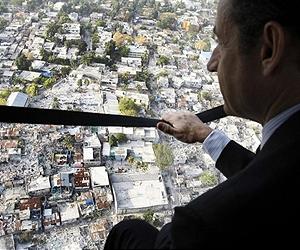
Nicolas Sarkozy on Wednesday became the first French president to visit Haiti, vowing to honor historic obligations to France's former slave colony and promising almost half a billion dollars in quake aid.
"I have come to tell the Haitian people and their leaders that France, which was the first on the ground after the catastrophe, will remain firmly at their side to help them pick themselves up again and open a new happy page in their history," Sarkozy told a press conference on the grounds of Haiti's damaged national palace.
Sarkozy announced an aid package of some 326 million euros (446 million dollars) over the next two years, a sum that includes the cancellation of Haiti's 56-million-euro debt.
"France will live up to the responsibilities of its shared history and friendship with Haiti," said Sarkozy, who was greeted by Haitian President Rene Preval at the start of his landmark trip.
Preval said he welcomed the French leader's visit, but would have preferred that it come "under other circumstances."
Sarkozy surveyed the devastated Haitian capital and other affected areas from the air, somberly peering out from the open side door of a helicopter, and visited a field hospital set up by French aid workers where he met with earthquake victims.
Hundreds meanwhile protested outside the presidential palace, calling on the French leader to use his influence to help bring about the return to Haiti of former president Jean-Bertrand Aristide.
The demonstrators, who appeared to be young people from the poorer sections of Port-au-Prince, held placards bearing messages like "Sarkozy, we want President Aristide to come home" and "Aristide should be allowed to take part in rebuilding of his country."
A 56-year-old former priest and champion of the poor, Aristide was Haiti's first democratically elected leader, but was forced to flee a popular revolt in 2004 following two stints as president. He remains in exile in South Africa.
Wednesday's visit was the first by a French president to this former French colony in the Caribbean, which fought for and won its independence in 1804, becoming the first independent black republic.
Alluding to France's colonization of Haiti, which at the time was a thriving center of sugar production, Sarkozy acknowledged "a common history that is rich, but also painful."
Ties between Haiti and France were violently ruptured as a massive slave revolt swept the island from 1791, claiming hundreds of lives and ultimately leading to the end of French rule 13 bloody years later.
"The wounds of colonization — and worse yet the conditions of our separation — have left behind unpleasant memories that linger for Haitians," Sarkozy said.
France ultimately agreed to relinquish its lucrative colony on the condition that the fledgling government pay 150 million francs to reimburse plantation owners who lost holdings there. Haiti finished paying off the crippling debt in 1885.
Asked by reporters about the painful chapter of slavery and colonial domination, Preval before the start of the visit, said: "History is history. We have overcome — politically and psychologically — this difficult period of our history."
Sarkozy's visit comes more than a month after the massive January 12 quake claimed more than 217,000 lives and left some 1.2 million people homeless on the Caribbean island of a little over nine million people.
He urged Haitian hosts to take their redevelopment and rebuilding into their own hands, saying the effort should be "a true national project" that focuses more on the provinces and far less on the area around Port-au-Prince.
According to the Inter-American Development Bank, the quake caused damages estimated at up to 14 billion dollars in what was already the poorest country in the Americas before the catastrophe, making it potentially the worst natural disaster in modern history.
The vast number of homeless from the quake are living in squalid camps in and around the capital.
Share This Article With Planet Earth
