
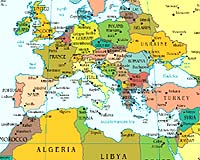
President Nicolas Sarkozy said Wednesday that defending human rights and action on global warming would be priorities for French diplomacy. Sarkozy also pledged in his inaugural address after taking over from Jacques Chirac as France's 23rd president to support the welfare state in Europe, create a Mediterranean Union and bolster development in Africa.
"I will fight for a Europe that protects because the European ideal is to protect the citizens of Europe," he said after taking office during a formal ceremony at the Elysee presidential palace.
"I will fight for a Mediterranean Union. By turning its back on the Mediterranean, France has turned its back on its past, and on its future," he said.
Sarkozy has proposed that countries along the Mediterrean rim in Europe, the Middle East and north Africa come together to bolster regional cooperation.
"I will fight for the development of Africa because the destiny of Europe and that of Africa are indisputably linked," he said.
"I will make the defense of human rights and the struggle against global warming priorities of France's diplomatic ation in the world," he said.
"The task will be difficult and it will take time."
Sarkozy, 52, was due to travel to Berlin later in the day for talks with Chancellor Angela Merkel, underscoring the importance of the Franco-German relationship.
earlier related report
Citizen Chirac begins new life under corruption cloud
Paris (AFP) May 16 – Jacques Chirac, who began a new life Wednesday after stepping down as France's president, plans to devote himself to fighting global warming and poverty — unless allegations of corruption come back to haunt him.
Following a symbolic handover ceremony in which Chirac passed on France's nuclear codes to his successor Nicolas Sarkozy, the president of 12 years was driven from the Elysee palace for the last time.
As a private citizen, Chirac confirmed in a farewell speech on Tuesday that he plans to set up a foundation devoted to causes close to his heart: protecting the environment and "dialogue between cultures".
Modelled after those set up by Mikhail Gorbachev, Bill Clinton and Nelson Mandela, Chirac's new foundation is to be launched in the fall, with former International Monetary Fund head Michel Camdessus at the controls.
But Chirac's immediate concern may be the prospect of being hauled in for questioning by a judge investigating allegations of illegal party-funding during his 18-year stint as mayor of Paris.
Under French law, Chirac's presidential immunity expires on June 16, a month after he leaves office.
A justice official has told AFP it is "most probable" that Chirac will be questioned as a witness in the probe into a kickback scheme in which workers for Chirac's former party, the Rally for the Republic (RPR), had salaries paid for by Paris city hall or companies that won contracts there.
The so-called "fake jobs" scandal led in 2003 to a series of prosecutions of senior RPR members, including Chirac's close ally Alain Juppe who received a suspended jail term in 2004 and a year-long ban on public office.
On Tuesday, Juppe — who is tipped to head a new super-ministry of the environment, energy and transport in Sarkozy's right-wing government — was questioned by judges in a connected investigation.
Sarkozy — whose presidential bid was endorsed by Chirac — last month angrily denied a report by the Canard Enchaine satirical weekly that the new president had struck a deal to shield Chirac from the corruption probe.
Rather than a specific amnesty for corruption, Sarkozy would introduce a provision as part of a new crime-fighting bill that would set a 10-year limit on the time a judge has to close a case, the weekly said.
That measure to be submitted to parliament in the fall would close the book on three corruption cases that date back more than 10 years, when Chirac was mayor of Paris from 1977 to 1995, according to the Canard Enchaine.
Chirac's office also denied the allegations as "scandalous".
As former head of state, Chirac automatically becomes a member of the Constitutional Council, France's highest constitutional authority, alongside Valery Giscard d'Estaing and nine other appointed members.
He will also be given an office and, according to the weekly L'Express, receive a pension totalling some 19,000 euros (26,000 dollars) per month.
On leaving the Elysee, Chirac and his wife Bernadette were taken to their new temporary home in an apartment on the river Seine overlooking the Louvre museum.
The Chiracs' apartment was loaned to them by the family of assassinated former Lebanese premier Rafiq Hariri, who was a close friend of the Chiracs. They are expected to stay there until they find a place of their own.
