
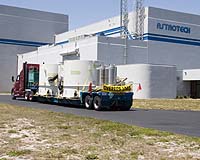
NASA's nearly identical twin STEREO spacecraft arrived Wednesday in Florida for their final pre-launch testing and preparations.
The spacecraft – officially named Solar TErrestrial Relations Observatory and designed and built by Johns Hopkins University's Applied Physics Laboratory in Laurel, Md. – are designed to capture from orbit the first-ever three-dimensional views of the sun and the solar wind.
During the two-year STEREO mission, the observatories will explore the origin, evolution and interplanetary consequences of coronal mass ejections. These powerful solar eruptions are a major source of the magnetic disruptions on Earth and a key component of space weather, which can greatly affect satellite operations, communications, power systems, and the lives of humans in space.
STEREO arrived by truck at the Astrotech Spacecraft Processing Facility just outside NASA's Kennedy Space Center, where they will be placed inside a clean room for final pre-launch checks. The twin satellites are scheduled for launch no earlier than July 22, aboard a single Delta II rocket from Cape Canaveral Air Force Station's Launch Complex 17, Pad B.
Before their trip to Florida, the STEREO twins completed five months of space-environment tests at NASA's Goddard Space Flight Center in Greenbelt, Md., and at APL. The tests simulated conditions the observatories will undergo during launch and their space-based operations. Throughout the next few months, the twin observatories will undergo final systems checks before they are loaded onto the launch vehicle.
That next step is scheduled to occur approximately two weeks prior to launch, or around July 8. Mission operations personnel at APL will begin the final countdown 12 hours before launch. STEREO's two-week launch window opens at 3:11 p.m. Eastern Time on July 22 and extends through Aug. 6, with two liftoff opportunities each day.
STEREO is the third mission in NASA's Solar Terrestrial Probes Program.
