
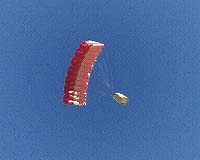
On September 25th, STARA Technologies was awarded a contract by US Army TACOM-ARDEC, Picatinny Arsenal, NJ to demonstrate the use of its existing miniature guided parafoil technology to deliver top-attack munitions from a lightweight Unmanned Aerial Vehicle (UAV).
The lightweight Unmanned Aerial Vehicle has proved itself as an effective reconnaissance tool in Iraq and Afghanistan. However the aircraft has not yet been able to perform as a successful strike platform because it can not bear the weight of conventional munitions.
The current advances in smaller and lighter submunitions is the first step towards converting the UAV into an attack aircraft. However, there is an additional problem.
The UAV's slow speed forces it to fly higher than the range of small arms fire making it difficult to place these submunitions on target. STARA's guided parafoil delivery system addresses this second issue, filling the gap between the armed, high flying UAV and the target below.
Unlike free falling conventional parachutes, STARA's guided parafoils incorporate Global Positioning Satellite (GPS) technology to autonomously fly towards a target while overcoming any winds encountered on the way down.
This will make it possible for the UAV to select targets with its surveillance equipment and then program STARA's units to accurately deliver submunitions to these targets, destroying them with lethal, pinpoint accuracy.
STARA's Chief Engineer Glen Bailey commented, "The use of the GDS to deliver submunitions from a UAV is definitely the attack platform of the future." He also indicated that while the system will be modified to drop munitions, the GDS can also be used to drop blood or survival equipment to wounded troops in remote areas.
