
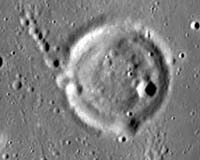
This image, taken by the advanced Moon Imaging Experiment on board ESA's SMART-1 spacecraft, shows one quarter of crater Hopmann – an impact structure about 88 kilometers (55 miles) in diameter.
AMIE obtained the image on Jan. 25 from a distance of about 840 kilometers (520 miles) from the lunar surface, with a ground resolution of 76 meters (250 feet) per pixel.
The imaged area, not visible from Earth because it is located on the Moon's far side, is positioned at latitude of 51.7 degrees south and longitude 159.2 degrees east. It covers a square of about 39 kilometers (24 miles) per side.
The crater, which is centered at 50.8 degrees south and 160.3 degrees east, is situated on the edge of the giant South Pole-Aitken basin SPA, the largest impact crater in the solar system with a diameter of 2,500 kilometers (1,550 miles) and a depth of 13 kilometers (eight miles).
The SPA basin shows distinctive chemical composition with unusual mineralogy types, and possible exposure of rocks from the lower crust or the upper mantle.
The hills on the lower left side are the crater wall of Hopmann. This crater is very old – many small craters can be seen on its flat floor, the largest one showing an interesting double-ringed structure. The outer rim has been eroded by later impacts.
Astronomers have interpreted the small crater chains to the left of Hopmann as series of secondary craters, created by the impact of the material ejected from a nearby large impact. This ejected material flies away in molten state, and falls in large droplets. When these impact on the surface, they form typical crater chains as those visible in the image.
The crater is named after German astronomer Josef Hopmann (1890-1975), who worked in Bonn and Leipzig, and as director of the Vienna Observatory.
