
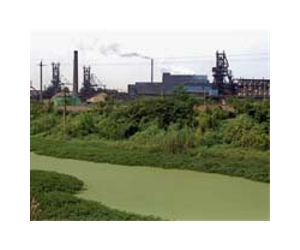
Around 200 activists gathered Sunday in the centre of the Russian city of Saint Petersburg to protest the impact on the environment of a series of government projects.
Among the schemes at the centre of the protest organised by Greenpeace was a plan to reopen a cellulose factory on the shores of Lake Baikal in Siberia as well as a stalled project to build a highway through a forest near Moscow.
The cellulose factory had closed in October 2008 but Prime Minister Vladimir Putin approved its reopening earlier this year despite warnings by ecologists of its impact on the lake's eco-system and the development of tourism.
The highway project, which forms part of a road linking Moscow with Saint Petersburg, is to cut through the Khimki forest, although it was put on hold by President Dmitry Medvedev over the summer following widespread protests.
Despite Medvedev's order, many environmentalists fear that the project will be resumed at a later date.
earlier related report
Italy faces massive fines failing garbage clean-up: EU
Brussels (AFP) Oct 23, 2010 –
Italy faces EU legal action and massive fines failing waste management improvement around Naples, scene of escalating clashes this week in its ongoing garbage crisis, a European commisioner said Saturday.
"I am worried by what has been happening in Campania in recent days," said Janez Potocnik, the commissioner for the environment, referring to the explosive situation in the Naples region.
"Today's situation leads us to believe that measures taken by Italian authorities since 2007 are insufficient," he said in a statement.
He said the Commission, the EU executive arm, was considering sending a team to the area to assess whether Italy remained in breach of European legislation requiring waste disposal installations that protect human health and the environment.
Europe's highest court in March found Italy in breach of EU legislation for its failure to clean up the Naples region garbage crisis declared by Prime Minister Silvio Berlusconi 18 months earlier.
Should the European Commission decide to refer the matter back to the court — the Luxembourg-based European Court of Justice — for a second time, and should it decide against Italy, the country would face a fine running into millions of euros.
The fines are calculated as a percentage of GDP, with day-by-day penalties added to a lump sum.
Berlusconi had made finding a solution to the 2007 garbage crisis a key plank of his winning campaign.
On Friday he promised compensation for Terzigno, the town near Naples where violent clashes erupted this week over plans to build Europe's biggest waste dump there. But local mayors rejected the offer, saying they will defend their territory at any cost.
"What has been happening in the last days shows that the Italian authorities have not yet done what is needed," the Brussels commissioner said.
The proof was that the Campania region still had no waste management and that the region's sole incinerator, in Acerra, "is not functioning properly and at full capacity," he added.
Italy was neither disposing of old waste nor able to manage new daily garbage production.
"The present situation has not changed compared to when the Commission decided to block EU funding," the statement said.
Share This Article With Planet Earth
