
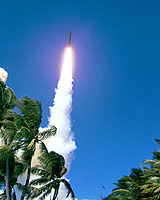
As always happens, deployment of U.S. military bases overseas will be accompanied by the formation of solid military infrastructures. Therefore, deploying U.S. anti-ballistic missile forces in Europe will deal a final blow to the treaty on Conventional Armed Forces in Europe. The CFE treaty has had one foot in the grave since the Baltic countries joined NATO without signing it.
First, the American ABM deployment area in Europe will have to be protected from the air, at least against terrorist attacks. In practical terms, it means that NATO's air force can move to the borders of Russia's ally, Belarus. Secondly, this area will require radars, which, in turn, will have to be thoroughly guarded as well.
Deputy head of the Main Department of International Military Cooperation Lt.-Gen. Buzhinsky believes that "NATO will build new facilities in the European deployment area under the pretext that they are required for the functioning of the ABM system. It will need other forces, such as the navy, air defense, aviation, and ground-based troops in order to protect the security of these facilities."
Moreover, Europe-based military installations may be used for other purposes. If need be, NATO could install attack missiles in silos after minor adjustments. Neither Russia nor its Collective Security Treaty Organization allies, Belarus in particular, can ignore these plans.
Indicatively, NATO has not yet made a decision on the ABM scale and structure, and for this reason the system will not be integrated into NATO's command network. Declarations about defense of the NATO countries by the ABM system mean that NATO will have to pay at least some of the expenses involved in maintaining its infrastructure. But at the same time, the residents of the countries with ABM deployment areas will risk being hit by the fragments of intercepted ballistic missiles and interceptor missiles, whereas decisions on launching anti-missiles will be made thousands of miles away from Europe.
Until recently, the Europeans believed that instead of building an ABM system with long-range interceptors, it made sense to upgrade existing air defense systems capable of intercepting ballistic missiles in Europe. It was not ruled out that Russian and Western systems could be used together for the protection of peacemaking operations. This idea was sealed in the declaration on new NATO-Russia relations, which was adopted in Rome in 2002.
After talks with his Polish counterpart Anna Fotyga, Russian Foreign Minister Sergei Lavrov made this statement on the reconfiguration of the U.S. military presence in Europe in general, and the third advanced ABM deployment there (after the United States and the Far East) in particular: "Let's not forget that NATO is discussing the building of its ABM system. In this context, reconfiguration may question strategic stability. I've told my counterpart that we are interested in these processes being transparent and understandable for us. Of course, we will take them into account while planning our own measures to ensure global strategic stability and Russia's national security."
In late August, replying to the proposal of his American colleague to replace nuclear warheads on strategic missiles with high-precision re-entry vehicles to fight terrorists, Russian Defense Minister Sergei Ivanov suggested considering withdrawal from the treaty on medium-range missiles. Former Air Force Commander Anatoly Kornukov mentioned Kaliningrad as a possible site for the deployment of C-400 air defense missile systems with a range of up to 250 miles.
Second of two parts
Nikolai Khorunzhy is a political commentator for the RIA Novosti news agency. This article is reprinted by permission of RIA Novosti.
United Press International's "Outside View" commentaries are written by outside contributors who specialize in a variety of important issues. The views expressed do not necessarily reflect those of United Press International. In the interests of creating an open forum, original submissions are invited.
Source: United Press International
