
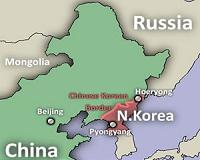
As Washington and its allies push for sanctions on North Korea after its latest nuclear test, Russian President Vladimir Putin has emerged as one of the most strident voices against punishing Pyongyang.
The United States, South Korea, Japan and EU are keen to ratchet up pressure on Kim Jong-Un by cutting oil supplies and freezing his assets, while President Donald Trump has not ruled out military action.
But Putin — whose country enjoys relatively warm relations with Pyongyang rooted in a Soviet-era alliance — insists further sanctions and threats are "useless" against a regime that feels cornered.
"They (North Koreans) will eat grass but will not give up this (nuclear) programme if they don't feel safe," Putin said at a summit in the Chinese city of Xiamen this week.
In pushing back against the West over North Korea, analysts say the Kremlin strongman is seeking to protect Moscow's long-term strategic interests and maximise his own short-term political gains as ties with the US remain in the doldrums.
Moscow has "completely cynical, geopolitical reasons," Andrei Lankov, professor at Kookmin University in Seoul and director at consultancy Korearisk.com, told AFP.
For the sake of regional stability and influence, the Kremlin will look to shield the Stalinist regime from serious retribution because Russia sees the current status quo as a lesser evil.
– 'Disastrous consequences' –
Moscow fears that if the confrontation with Pyongyang spirals into a punitive strike or regime change then that could create chaos — and a potential new democratic US ally — on its border.
Lankov said the Kremlin — which has repeatedly voiced concern over NATO encroaching on its borders — does not want a new "democratic, national, pro-American" state on its eastern flank if the Kim dynasty is ousted.
"That scenario does not suit either China or Russia," said Lankov, who lived in the isolated state and is the author of "The Real North Korea: Life and Politics in the Failed Stalinist Utopia."
The prospect of a US nuclear strike and subsequent chaos and a refugee exodus is even more scary than a democratic country on Russia's doorstep, said another Korea scholar, Alexander Zhebin.
"A military conflict on the peninsula would have disastrous consequences for the Koreans and the entire region," said Zhebin, director of the Center for Korean Studies at the Russian Academy of Sciences, adding that South Korea — with its 25 nuclear reactors – was especially vulnerable.
"Where would 70 million people go to live?" said Zhebin, referring to a combined population of the two Koreas. "Radiation will also badly affect Russia and China."
While the doom-and-gloom scenario is still seen by many as an unlikely occurence, experts say Putin is seeking to use the global jitters to reap benefits on the international arena.
– 'Trump card' –
Promoting himself as a negotiator capable of dealing with pariah regimes, Putin will once again polish his foreign policy credentials ahead of a 2018 presidential election which he is expected to win.
The veteran Kremlin leader has positioned Moscow as a buffer between a bellicose Trump and unyielding Kim and is keen to be seen as a voice of reason amid all the super-charged rhetoric.
Over the past days, he has discussed Korea with foreign leaders as he sought to impart his knowledge of the North to his counterparts.
He says Kim would not forget the fate of Libyan dictator Moamer Kadhafi who gave up his country's nuclear programme but ended up being killed in an uprising in 2011.
Russia, a veto-wielding permanent member of the UN Security Council, has refused to say whether it will support a draft sanctions resolution against North Korea.
Washington wants to have a vote at the Security Council on Monday, diplomats say.
By contrast, Moscow and Beijing, North Korea's sole major ally, have called for a simultaneous freeze on North Korean nuclear and missile tests and military exercises by Washington.
"As practice shows, China does not decide anything — either it can't or does not want to or both. And other countries can count on Russia becoming a communication channel," said Andrei Baklitskiy, an expert with PIR Center, a Moscow think tank.
"This can be used by Russia as a trump card."
Fyodor Lukyanov, the Kremlin-connected chairman of the Council on Foreign and Defence Policy, wrote in a government paper that whoever will manage to solve the Korea crisis and force Pyongyang to back down, will become the "most influential 'free agent' in Asia."
Lavrov says too early to discuss final UN vote on N.Korea
Moscow (AFP) Sept 8, 2017 –
Russian Foreign Minister Sergei Lavrov said on Friday it was too early to talk about a vote at the UN Security Council on new North Korea sanctions, insisting any pressure should be balanced against restarting talks.
"Work is currently going on over a new resolution in the Security Council and it is still early to make predictions about its final form," Lavrov said at a news conference with French counterpart Jean-Yves Le Drian.
"Along with pressure on the North Korean regime to induce it to abandon provocations in the implementation of its nuclear and missile programmes, it is necessary to emphasize and increase the priority of efforts to resume the political process," Lavrov said.
The United States has presented a draft UN resolution calling for an oil embargo on North Korea, an assets freeze on leader Kim Jong-Un, a ban on textiles and an end to payments of North Korean guest workers.
Washington is determined to have a vote at the UN Security Council on Monday on imposing the tough new sanctions against Pyongyang, UN diplomats said.
The United States wants to maximise pressure on Pyongyang to come to the table and negotiate an end to its nuclear and missile tests.
Russian President Vladimir Putin has repeatedly said that new sanctions will not help persuade Kim to drop his nuclear programme.
Security Council permanent member Moscow has not said explicitly however that it will veto the US plans.
The proposed sanctions would be the toughest-ever imposed on North Korea and seek to punish Pyongyang for its sixth and largest nuclear test.
China's Xi asks Macron for French help easing N. Korea tensions
Beijing (AFP) Sept 8, 2017 – Chinese President Xi Jinping called on France to help ease the situation in North Korea during a phone call with French President Emmanuel Macron, state media said Friday, days after Pyongyang's largest ever nuclear test.
The conversation came one day after statements from China supporting stronger sanctions against Pyongyang and "necessary measures" at the UN Security Council, where China and France both hold vetoes.
"China hopes that France, as a permanent member of the UN Security Council, will play a constructive role in easing the situation and restarting dialogue" on North Korea, Xi said, according to state broadcaster CCTV.
North Korea triggered global alarm Sunday with its most powerful nuclear blast to date, claiming to have successfully tested a hydrogen bomb.
During the call, the Chinese leader expressed his desire for the "denuclearisation of the Korean Peninsula," which he had also noted during a conversation with German Chancellor Angela Merkel hours earlier.
Macron told Xi that France is willing to strengthen cooperation with China to promote the proper settlement of the nuclear issue.
Macron "reiterated the international community's condemnation of North Korea's provocations," the French president's office told AFP.
"These provocations call on the international community to place new pressure towards the goal of bringing Pyongyang back to negotiations and avoiding dangerous escalations," it said.
On Thursday, Chinese Foreign Minister Wang Yi had said: "China agrees that the UN Security Council should respond further by taking necessary measures."
Earlier, Merkel's spokesman Steffen Seibert said the German leader and Xi both agreed to support tougher sanctions against North Korea.
China, which is the North's biggest ally and accounts for 90 percent of its trade, is seen as key to efforts to convince Pyongyang to abandon its weapons programme.
Japan, S.Korea push Putin over Pyongyang sanctions
Japanese Prime Minister Shinzo Abe on Thursday echoed South Korea's demand for more pressure on Pyongyang after its nuclear tests as the leaders of the two countries looked to grind down resistance from Russia's Vladimir Putin.
"The international community must unite in applying the greatest possible pressure on North Korea," Abe said in a speech alongside Putin and South Korea's Moon Jae-in … read more
