
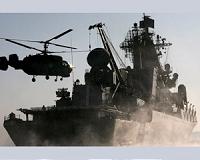
Russian troops taking part in the country's largest-ever war games on Saturday held drills in the Sea of Japan, despite Tokyo's concerns about a Russian military buildup in the area.
The exercises were part of the Vostok-18, or East-18, war games that kicked off in eastern Russia on September 11 and will run until Monday.
Defence Minister Sergei Shoigu has described the week-long operation, which involves nearly 300,000 soldiers, 36,000 vehicles, 1,000 planes and 80 warships, as Russia's biggest-ever war games.
They are also taking place in eastern Siberia and the far-eastern Pacific region, with Chinese troops involved.
On Saturday, the armed forces simulated marines capturing a shoreline area at the Klerk military training ground on a peninsula in the far eastern Primorye region supported by aviation and artillery.
"What's special about this exercise is that it involves the marines, aviation, warships from the Pacific Fleet, artillery, sappers and other specialists," Major-General Dmitry Kovalenko told journalists.
Japan has raised concerns over Russia's military buildup in the region, particularly on the Kuril Island chain, four of which are claimed by Tokyo in a dispute dating back to World War II that has prevented the two nations from ever signing a peace treaty.
Speaking Thursday as he watched the drill, President Vladimir Putin promised to "further reinforce" the armed forces and supply them with "the latest generation weapons and technical equipment" at a time of rising tension in Moscow's ties with Washington and Brussels.
While Russia insists the war games are long-planned and purely defensive in nature, NATO has said that they are simulating "large-scale conflict."
Japan conducts first submarine drill in disputed South China Sea
Tokyo (AFP) Sept 17, 2018 –
Japan has carried out its first submarine drill in the South China Sea, local media said on Monday, a move that could provoke Beijing which claims most of the disputed waters.
The anti-submarine drill was conducted on Thursday in the region to "improve strategic techniques", Japan's defence ministry said in a short statement.
Prime Minister Shinzo Abe defended the drill, which he said does not aim to target "a particular nation."
Neither Abe nor a ministry spokesman said whether it was the first such exercise there.
The Asahi Shimbun newspaper said the submarine Kuroshio joined three Japanese warships in waters just southwest of the China-controlled Scarborough Shoal.
China claims most of the resource-rich South China Sea, through which $5 trillion in shipping trade passes annually, despite competing claims from Brunei, Malaysia, the Philippines, Taiwan and Vietnam.
Tensions have been high over the Scarborough Shoal since Beijing seized it from Manila in 2012.
The newspaper said the one-day submarine exercises were Tokyo's first in the South China Sea.
The Maritime Self-Defence Force carried out a "practical" anti-submarine drill, including an exercise to spot enemy submarines with sonar devices, the Asahi said, quoting government sources.
The sources described it as a legitimate naval exercise in neutral waters, with rights of access under international law.
Abe stressed that he agreed with Chinese President Xi Jinping earlier this month that he will visit Beijing soon, saying Japan-China relations have entered "a new stage."
Chinese foreign ministry spokesman Geng Shuang declined to confirm the drill, but said that "the situation in the South China Sea is improving."
Japan "should act cautiously and avoid doing anything which would harm regional peace and stability", he told a regular press briefing.
Following the drill, the Japanese submarine made a port call on Monday at Cam Ranh in central Vietnam to promote defence cooperation with Hanoi, Japan's defence ministry said in a separate statement.
The submarine with 80 people aboard will stay until Friday.
It was the first call by any foreign submarine at the strategically important port, a defence ministry spokesman said, citing a Vietnamese counterpart.
China has engaged in years of land-reclamation work on reefs it controls in the South China Sea and has built both civilian and military facilities on them.
Earlier this month Beijing lashed out at Britain for sailing a warship close to the disputed islands — one of a series of "freedom of navigation" exercises carried out in recent years by the US and its allies.
