
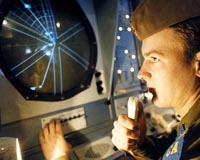
Russia's defence ministry on Sunday denied a report by Swedish military that a Russian military plane nearly collided this week with a passenger plane over Sweden.
Russia's defence ministry did not deny that its plane was in the area at the time of the incident on Friday, but said that it was at a safe distance of more than 70 kilometres (43 miles) from the flight path of the passenger jet.
The incident happened amid growing concern in the Baltic region over signs of more assertive Russian behaviour, including Russian planes skirting or violating the national airspace of neighbouring countries.
"There were no conditions for an aviation incident connected to the flight on Friday December 12 of a Russian military plane in the international airspace over the Baltic Sea," defence ministry spokesman Igor Konashenkov told TASS news agency.
"The distance from the flight path of the passenger jet that took off from Copenhagen was more than 70 kilometres," he added.
The spokesman confirmed the Swedish defence ministry's statement that the Russian plane was flying without an electronic identification device called a transponder that would have made it visible on the radar of a commercial plane.
Sweden's Defence Minister Peter Hultqvist described flying without a transponder as "irresponsible".
But the Russian military spokesman countered that military planes from NATO countries that fly in airspace close to Russia's borders are also "always carried out with the transponder switched off".
"This doesn't mean that Russia's means of controlling the airspace do not spot them," he said.
US Congress passes Russia sanctions, arms for Ukraine
Washington (AFP) Dec 14, 2014 –
The US Congress on Saturday unanimously approved fresh economic sanctions against Russia and lethal weapons for Kiev, defying President Barack Obama and hardening American lawmakers' response to a Kremlin-backed insurgency in Ukraine.
Identical texts of the Ukraine Freedom Support Act passed both the Senate and House of Representatives on Thursday, but because of a technical issue it returned to the Senate where it passed by unanimous consent moments before the chamber adjourned late Saturday night.
It is now up to Obama to either sign or veto the measure. The White House said Thursday it was "looking at it."
On Saturday, one day ahead of a meeting between Russian Foreign Minister Sergei Lavrov and US Secretary of State John Kerry, Moscow warned that "undoubtedly, we will not be able to leave this without a response."
The legislation authorizes — but does not legally require — Obama to provide lethal and non-lethal military aid to Ukraine, including anti-tank weapons, ammunition and troop-operated surveillance drones.
Washington backs Ukraine in its conflict with Russia, but Obama has yet to approve the bulk of an arms request by Kiev.
"The hesitant US response to Russia's continued invasion of Ukraine threatens to escalate this conflict even further, warned bill coauthor Senator Bob Corker.
Congressional passage heaps political pressure on Obama.
On Thursday he signalled he was against unilaterally putting the economic squeeze on Moscow, saying it would be "counterproductive" for Washington to "get out ahead of Europe further" on sanctions.
In November, the Pentagon delivered the first of 20 anti-mortar radar systems to Ukraine.
The current legislation authorizes $350 million worth of weapons, defense equipment and training for Ukraine over three years.
Lawmakers dropped a key provision in the original bill that would have taken the rare step of giving major non-NATO ally status to Ukraine, Georgia and Moldova.
Senate aides said the provision was removed at the 11th hour in order to ensure final passage.
The measure hits Russia's defense and energy sectors, punishing companies like state defense import-export company Rosoboronexport.
It requires Obama to impose conditional sanctions on the defense sector should Russian state-controlled firms sell or transfer military equipment to Syria, or to entities in Ukraine, Georgia or Moldova without the consent of the governments in those nations.
The rule is aimed at helping stem the flow of weapons from Russia across the border into eastern Ukraine, where Washington and Kiev accuse Moscow of fomenting separatist unrest.
It also gives Obama authority to penalize Russian gas giant Gazprom if it is found to be withholding significant natural gas supplies from NATO states, or Ukraine, Georgia, or Moldova.
